What should I check before attributing rising acetylene in transformer oil to a fault?
First confirm that the rise is real and comparable. Put the reports in collection-date order, check asset, compartment, units, methods and qualifiers, and remember that acetylene near the detection limit, a censored result or contamination from a preceding tap-changer sample can mimic an increase. Acetylene alone cannot separate a thermal process from a discharge, so request a documented confirmation sample with the full gas panel while independent alarms keep their own response.
Before assigning a fault to rising acetylene, establish whether the increase is resolved by the measurements, which compartment was sampled and what else changed. A confirmation request does not suspend the owner's response to independent alarms.
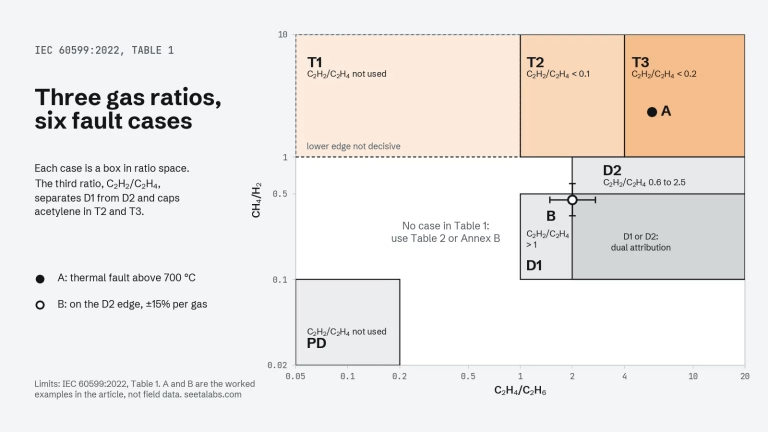
Acetylene is an important indicator of arcing-related processes in mineral oil, as discussed in IEEE C57.104-2019, Clause 6.2.1. It is not exclusive to electrical discharges: CIGRE TB 771 (2019), Appendix H.7, reports its formation in laboratory oil pyrolysis without arcing. Its presence alone cannot distinguish a thermal process from a discharge or locate the source.
Establish what "rising" actually means
Put the original reports in collection-date order. Confirm asset, compartment, units, methods and qualifiers. An earlier <1 ppm entry followed by a quantified 0.7 ppm is not evidence of an increase: the reports provide different kinds of information.
Check laboratory capability at these concentrations. IEEE C57.104-2019, Clause 5.2.1, cautions about fault identification when acetylene is low relative to the detection limit. A positive arithmetic difference may not resolve a physical change.
Preserve the result, notify the responsible diagnostic engineer and arrange confirmation. Protection or operational evidence may require action under the owner's procedures while DGA quality is checked.
Collect evidence that separates the explanations
| Evidence to obtain | Question it helps answer | What it cannot prove alone |
|---|---|---|
| Confirmation sample with documented collection | Is the reported pattern reproducible? | Exact fault location |
| Full gas panel and earlier comparable results | Is acetylene part of an evolving mixture? | Unique physical defect |
| OLTC arrangement and communication paths | Could switching gases reach this sample? | Amount transferred without further evidence |
| Sampling sequence, tubing and laboratory checks | Could contamination explain a trace result? | That every unusual sample is erroneous |
| Protection, disturbance and maintenance timestamps | Did a relevant event precede the change? | Causation from timing alone |
| Load, temperature and cooling history | Does gas behaviour track operating conditions? | A universal safe loading level |
The contamination checks reflect IEEE C57.104-2019, Clauses 5.1.3-5.1.5; Clause 4.3.4 addresses event and gas-transport context.
Arcing-in-oil OLTC equipment can produce acetylene during intended operation. IEEE C57.139-2015, Clause 4, treats that separately. Document any communication route from the equipment; do not infer one from the gas result alone.
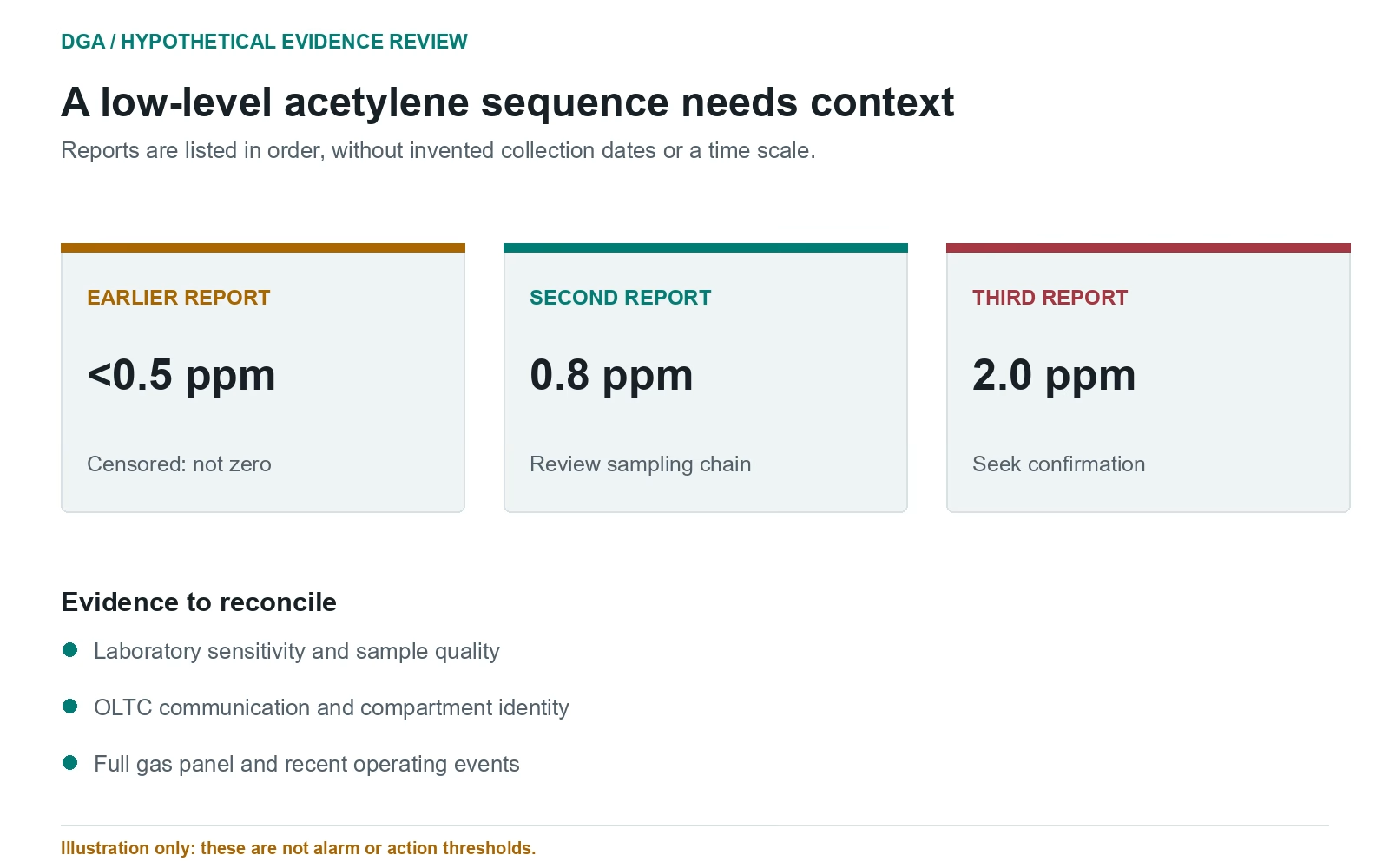
Work a hypothetical low-level case
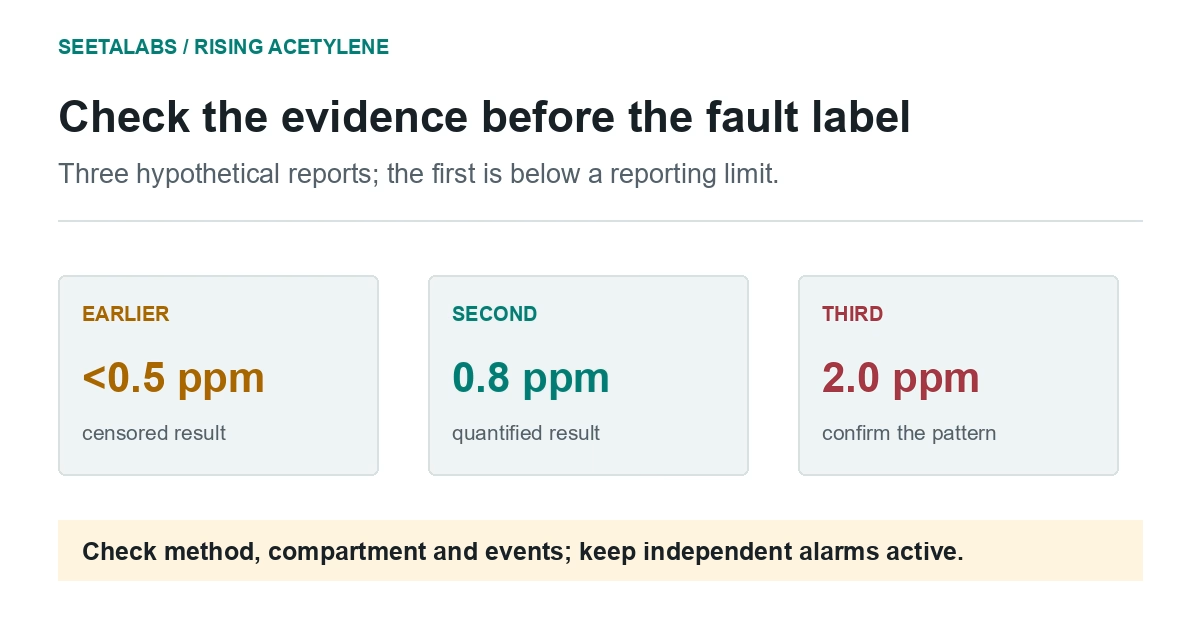
Three reports show acetylene <0.5 ppm, 0.8 ppm and 2.0 ppm. The first is censored, not a measured zero. The two quantified observations suggest a rise, subject to the laboratory's low-level uncertainty.
Suppose the second bottle followed an OLTC sample and the record does not show whether tubing was changed or cleaned. That creates a contamination hypothesis; it does not explain away the third result.
Request a documented confirmation sample and full gas panel; check OLTC communication and recent events. Reproduction under controlled sampling weakens the contamination explanation. Consistent changes in other gases strengthen the case for a developing process.
These hypothetical concentrations are not action thresholds or an assigned fault class.
Write an assessment that preserves urgency and uncertainty
A review note should identify the supporting samples, analytical limits, fluid and compartment, open explanations and next review point.
Neither "acetylene means stop" nor "the concentration is small, so nothing is happening" follows from these data. A Duval label is not an exact fault temperature or failure probability.
A Duval classification can support the DGA assessment once method applicability and measurement quality are established. Ester-filled units need fluid-specific interpretation; this mineral-oil discussion supplies no ester acetylene limit.
References: IEEE C57.104-2019, Clauses 4.3.4, 5.1.3-5.1.5, 5.2.1 and 6.2.1; IEEE C57.139-2015, Clause 4; CIGRE TB 771 (2019), Appendix H.7, p. 71. Relevant licensed passages checked as of 25 September 2026. The laboratory pyrolysis observation is not a field temperature estimator. No universal threshold or operating directive is proposed.