Is acetylene in an on-load tap changer compartment always normal?
No. An OLTC can produce acetylene during normal switching in oil, so main-tank expectations do not apply, but calling all OLTC acetylene normal is the opposite mistake. Interpret it by mechanism, compartment and operating history, and read a warning from the ratio limits of IEEE C57.139-2015 rather than from the plotted Duval Triangle 2 zone alone.
An on-load tap changer can produce acetylene during normal switching in oil. Applying main-tank expectations to its separate compartment can therefore create a misleading alarm. The opposite shortcut is just as unhelpful: calling all acetylene normal because it came from an OLTC.
Interpretation starts with the mechanism, the compartment and the operating history. Ratios, concentrations and a Duval Triangle 2 point describe different aspects of that evidence. A plotted zone is not automatically the sample's result code, and a Normal code is not a certificate of mechanical health.
Method and edition. Seetalabs® OLTC DGA Check version 1.0.4 (October 2026) applies IEEE C57.139-2015. IEEE lists C57.139-2026 as its active successor. A technical comparison with the 2026 edition has not been completed, so this article explains the 2015-based method without claiming equivalence or compliance with the successor. IEEE 2015 entry, 2026 entry.
Identify the oil and the mechanism
This workflow is for mineral-oil OLTCs. Record whether interruption occurs in oil or vacuum, the resistor/reactor principle, the presence of an arcing selector or bypass, and the breathing arrangement. Do not infer those details from the gas pattern. Sampling dates, operation counts, oil changes and repairs belong beside the measurements.
The distinction matters within vacuum designs too. In the tool, a vacuum reactor design without an arcing selector uses Triangle 1 as an interpretive note and excludes Triangle 2 from its score. A vacuum design of unknown principle cannot be treated as that known configuration. The default arcing-in-oil ratio thresholds do not automatically apply to vacuum units.
Keep the three calculations distinct
Heating-gas total: TDHG = CH4 + C2H6 + C2H4. Acetylene is not part of this total. If ethane is missing, the present software can show a partial total with a warning; that is not a measured complete TDHG. Restore the missing measurement before relying on comparisons that require the complete sum.
Ratio assessment: both terms must meet the tool's minimum concentration thresholds. It uses 10 ppm for an individual gas and 15 ppm for TDHG. Clause 5.2.1 of the 2015 guide suggests 10 ppm for a gas and a range of 10-15 ppm for TDHG. The tool uses the upper end, 15 ppm, to reproduce Annex C Example 1, where ratios were not considered meaningful before 2006. A higher threshold computes fewer ratios; it is not a more cautious setting. These thresholds are not each laboratory's certified detection limit.
For arcing-in-oil units without user-supplied ratio limits, the tool applies the default ethylene/acetylene limits given in clause B.3 of Annex B: Caution above 0.5 and Warning above 1.0. Restricting them to arcing-in-oil designs is a software choice. They are starting values to check against population experience, not universally validated limits for every model. Equality does not count as exceeding a limit: exactly 1.0 is Caution, not Warning.
Triangle assessment: Triangle 2 normalises methane, ethylene and acetylene, not TDHG. The tool may plot a point while withholding its contribution to the result because one of those gases is below 10 ppm. Clause D.2 of Annex D discusses reliability relative to the method detection limit; the fixed 10 ppm threshold is a Seetalabs® interpretation, not a substitute for the analytical report's uncertainty.
Clause 6.3.1 combines concentration and ratio scores. The tool additionally assigns Caution to a scored Triangle 2 point outside the applicable normal zone. That addition is explicitly a Seetalabs® interpretation; it is not an IEEE table assigning result codes to triangle zones. Model-specific extra normal zones require supporting population or manufacturer evidence, not selection simply to make an abnormal point disappear.
A plotted X3 point, but a warning from the ratio
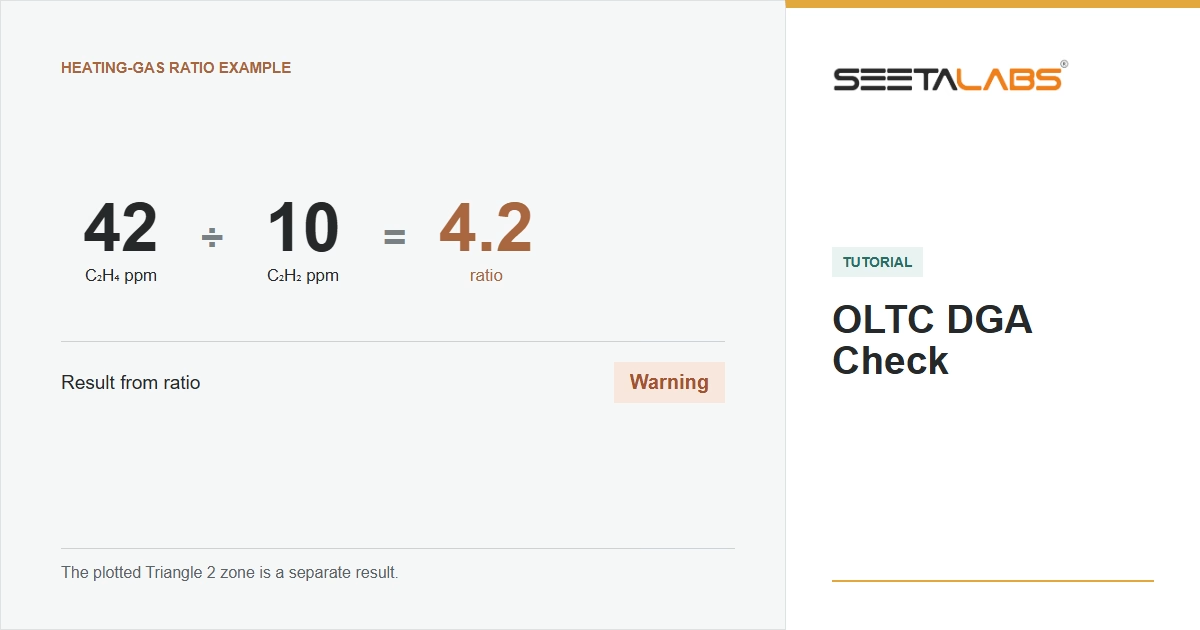
The 2006 sample in Annex C Example 1 supplies a useful numerical check. The hydrocarbons are CH4 7, C2H6 10, C2H4 42 and C2H2 10 ppm. The supporting values are H2 0, CO 121 and CO2 903 ppm. These are source example values, not new measurements from a Seetalabs® customer. IEEE C57.139-2015, Annex C.
The heating-gas total is 7 + 10 + 42 = 59 ppm. The triangle denominator happens also to equal 59 ppm: 7 + 42 + 10, using acetylene instead of ethane. Those sums coincide only because ethane and acetylene both equal 10 in this example.
The normalised triangle point is approximately 11.86% methane, 71.19% ethylene and 16.95% acetylene. The tool places it in X3 but does not score it, because methane is below its 10 ppm threshold.
The ethylene/acetylene ratio is independently usable: 42 / 10 = 4.2, above the default Warning boundary. With no earlier confirmation sample supplied, the software returns Warning and requests an immediate check sample. The warning comes from the ratio, not from X3.
TDHG/acetylene is 59 / 10 = 5.9. It is displayed but unscored unless limits for that ratio are supplied. Entering concentration limits alone does not enable its scoring. With the example population's ratio limits, both ratios exceed their Warning values. Keep this distinction when comparing the source case history with a default-settings tool run.
Why Normal depends on coverage
Annex C Example 2 shows the other direction. Its 2005 sample has ethylene 845 ppm and acetylene 3300 ppm, giving a ratio of about 0.256. The triangle is N and the default ratio assessment is Normal. When the example's population concentration limits are included, both concentrations exceed their respective limits and the result becomes Caution. The measurements did not change; the available comparison criteria did.
Those population limits are specific to the source example, not recommendations for the reader's fleet. The tool does not derive defensible fleet norms automatically. A result without concentration limits means that part of the assessment is absent, not that concentrations have been proved acceptable.
Preserve the history and the qualifications
Oil replacement or repair starts a new comparison baseline. Do not divide an apparent gas increase by a reset operation counter or mix pre-change and post-change oil as one uninterrupted accumulation interval. Even a valid per-operation change is an indicator, not a direct measurement of gas generation in a breathing compartment.
OLTC DGA Check rejects <5 as "not a number". If the qualifier is on methane, ethylene or acetylene, no result is produced; on another gas, the assessment continues without that gas. Unlike the Seetalabs® DGA Calculator and Fleet DGA Triage, it does not evaluate both ends of the censored interval. Do not remove the less-than sign or substitute zero to force acceptance. Preserve the laboratory qualification and obtain an appropriate interpretation outside that numeric pathway.
Finally, read data-quality and safety notices alongside the result code. A formal Caution result does not cap the physical hazard. This tool does not assess dielectric breakdown, water content or mechanical integrity, and no code authorises continued operation by itself.
Assess your sample in OLTC DGA Check.