Does retrofilling a transformer with ester automatically allow shorter fire separation distances?
No. A drum certificate describes the supplied liquid, not the mixture left in the transformer, and residual mineral oil can lower the fire point of the ester. Obtain representative fire-point measurements after the residual liquid has equilibrated, and confirm the equipment design, approval conditions and site layout with the insurer or authority. An FM Approved liquid and an FM Approved transformer are different cases.
Replacing mineral oil with ester changes the liquid, but it does not automatically qualify an existing transformer for shorter fire separation distances. The installed mixture, the equipment design, the approval conditions and the site layout all matter. A drum certificate describes the supplied liquid; it does not measure the mixture that remains in the transformer after retrofill.
The useful comparison is therefore between the present installation, an unconfirmed retrofit and a measured, project-approved outcome. Seetalabs® Ester Retrofill & Fire Risk version 1.0.7 (October 2026) compares those scenarios. Its favourable scenario is not evidence that the retrofit has achieved it.
Check the mixture, not only the new liquid
Oil retained in paper and other internal spaces is not all removed by draining. As it mixes with the replacement liquid, the mineral-oil fraction and the fire properties can differ from those of unused ester. Obtain representative measurements after the residual liquid has equilibrated; do not assume a universal waiting period or a typical residual percentage.
For natural ester, the tool uses 4% residual mineral oil as its conservative screening boundary. That reflects the 4% discussion in CIGRE TB 537 section 6.5.4, while IEEE C57.147-2018 section 1.4 notes a typical maximum of 7% and directs the user to the liquid manufacturer. Neither number is a universal acceptance certificate. The tool flags residual values above 4% and up to 7% as disputed rather than resolving them by interpolation. IEEE C57.147-2018.
For synthetic ester, IEC 61203:2025 Annex B.1 gives an example in which more than approximately 3.5% mineral oil by volume can lower the fire point below 300 C. It requires a case-specific assessment of the permitted residual amount. This is a warning about mixtures, not a guarantee that every result below 3.5% is acceptable. IEC 61203:2025.
The natural-ester curve represents the mixture experiment reproduced in IEEE C57.147-2018 Figure B.4. It is not a laboratory measurement of this asset. Fire point must also be kept separate from flash point: one reported value cannot stand in for the other, and a closed-cup flash result cannot simply be substituted for an open-cup test result.
The 300 C boundary needs precise wording
In the tool, the IEC K-type scenario requires a fire point above 300 C, following the classification reproduced in IEEE C57.147-2018 Annex C. This comparison does not establish compliance with all requirements of IEC 61039. The tool's FM liquid scenario uses an FM Approved ester and a measured fire point of at least 300 C. Applying that scenario to a retrofilled mixture still requires confirmation of the approval conditions with the insurer.
A result of exactly 300 C therefore does not activate the same branches. Nor should a rounded value of 301 C be treated as an automatic engineering acceptance: consider the test method, reporting precision, uncertainty and agreed acceptance rule.
FM DS 5-4 discusses replacement of mineral oil with ester: for power transformers of voltage class 69 kV or higher, section 2.1.3.6.1 G asks for a design review by the transformer manufacturer. Changing the liquid alone does not establish the installed unit's eligibility for a particular approval category. An FM Approved liquid and an FM Approved transformer are different cases. FM Global Property Loss Prevention Data Sheet 5-4, Transformers, July 2019, interim revision October 2025.
A 1500 L outdoor example
Consider the tool's built-in example "Urban substation, 1 500 L, office building 5 m away, natural ester": a mineral-oil transformer proposed for natural-ester retrofill, outdoors, with no enhanced-protection credit, 5 m to a non-combustible wall and 2 m to the neighbouring transformer.
These inputs require a geometry check before reuse on a real site. Under "Distances measured from", choose the inner edge of the oil containment for the FM comparison or the transformer for the IEC comparison. The same number must not silently represent both measurements. For this first run, select "the inner edge of the oil containment (FM Global)". A comparison with the other reference can remain "not decided"; record the actual dimensions separately before evaluating that framework.
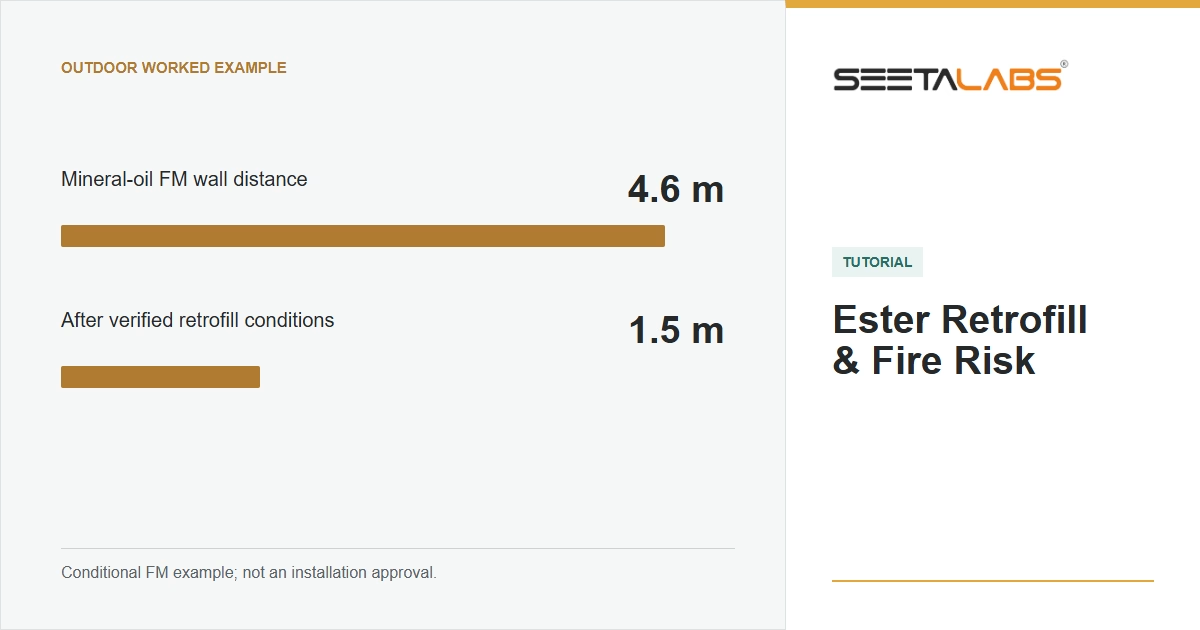
At 1500 L, the implemented FM mineral-oil case gives 4.6 m to the non-combustible wall and 1.5 m to the adjacent transformer. The entered containment-based distances exceed those values. The IEC Table 4 oil-insulated case gives 3 m for both comparisons, but the 2 m containment-based input cannot establish an IEC shortfall: its result is "not decided". In a separate run where 2 m is the actual transformer-based separation and that reference is selected, the IEC comparison is 1 m short. The corresponding FM comparison then remains undecided without its own measurement. IEC 61936-1:2021.
Three runs make the decision boundary visible:
- No measured fire point: the expected scenario retains the mineral-oil distances, even with a low entered residual fraction. The separate "if confirmed" column is a hypothetical comparison.
- Measured 300 C and an FM Approved ester: the measured scenario gives FM distances of 1.5 m in this example, subject to approval of their application. Its IEC branch remains at 3 m: the 2 m comparison remains undecided with containment-based measurements, or short when 2 m is measured from the transformer.
- Measured 301 C and an FM Approved ester: the tool selects 1.5 m for both frameworks in this specific geometry. Each comparison still needs its own measurement reference; a selected distance requirement is not measurement acceptance or installation approval.
Without the FM Approved-liquid condition, that framework retains the non-Approved-liquid distances even when the fire point exceeds 300 C. A combustible wall also changes the result: 1.5 m is not the answer for every wall or volume.
Limits of the comparison
IEC Table 4 provides outdoor clearance guide values within a wider fire-risk assessment. A value below its 1000 L scope is not a declaration of no fire precautions. Indoor installations, barriers, roof exposures, containment and enhanced protection require their own checks; the outdoor example does not establish compliance with those provisions.
The tool selects FM bands in US gallons and warns where rounded metric equivalents would select a different band. Thus 5000 US gal is approximately 18,927.1 L, not exactly 19,000 L: 19,000 L is already above that boundary. Likewise 10,000 US gal is approximately 37,854.1 L. Wall and adjacent-transformer tables are treated separately. Where a printed equality is not covered, the tool flags its choice of the more restrictive band. This is a declared software convention, not authority to resolve every ambiguity in a project specification.
Finally, retrofill does not repair pre-existing dielectric or mechanical defects. Suitability of seals, materials, cooling and protection remains an engineering question. Keep the laboratory reports, liquid approval evidence, drawing dimensions and insurer/authority decisions in the project record. The calculation is one input to that review, not its sign-off.
Compare your installation in Ester Retrofill & Fire Risk.