Why is one oil sample Poor under IEC 60422:2024 but Not Class I under IEEE C57.106-2015?
Because the labels belong to different classification systems, and the comparisons may not assess the same properties. In a worked example with seven measurements, the IEC 60422:2024 profile scored seven properties while the IEEE C57.106-2015 profile compared only water, acidity and interfacial tension, excluding entries defined under other conditions. Check which values entered each calculation, which were excluded and which edition applies before discussing maintenance.
An oil sample can receive a Poor result in one comparison and Not Class I in another without either calculation being inconsistent. The labels belong to different classification systems. More importantly, the calculations may not have assessed the same properties.
Consider a report with seven measurements. If a comparison accepts only three, its headline is not a verdict on all seven. Before discussing maintenance, establish which values entered the calculation, which were excluded and why.
On this page (5 sections)
Start with the equipment and the edition
Record the fluid, service state, compartment, voltage class and test methods before selecting a profile. New oil received from a supplier is not the same assessment case as oil already in service. A main-tank sample must not silently inherit an on-load tap-changer context. For the worked example below, Um means the highest voltage for equipment, not an unspecified nominal system voltage.
Category A and Poor are not competing classifications. In the IEC profile used here, A identifies the equipment category; Poor describes a scored property. The equipment does not move from Category A to Poor when a measurement deteriorates.
Edition status also matters. IEC lists IEC 60422:2024 as its fifth edition, published on 18 July 2024. Its public scope concerns supervision and maintenance of mineral insulating oil. It explicitly places equipment-condition assessment through dissolved gases and furans outside that scope. An oil-condition result is therefore not a replacement for transformer fault diagnosis.
The public 2013 corrigendum record carries a withdrawal date of 18 July 2024 and points to the 2024 edition. The IEEE C57.106-2015 record is Inactive-Reserved, with an inactivation date of 26 March 2026. A historical profile can help explain an earlier report; that does not make these three profiles interchangeable current acceptance criteria. Establish the edition required for the actual assessment separately.
A seven-measurement example
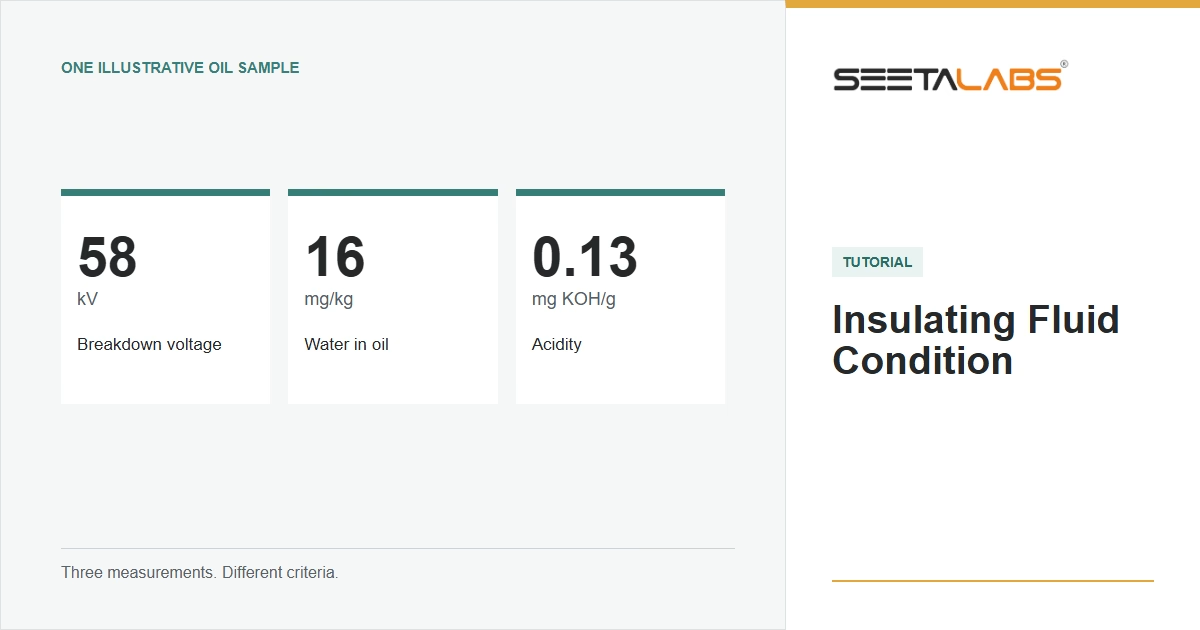
Use an illustrative generator step-up transformer with inhibited mineral oil, main-tank service and Um of 245 kV. The sample temperature is 52 degrees C. Enter breakdown voltage of 58 kV, water of 16 mg/kg, acidity of 0.13 mg KOH/g, dissipation factor at 90 degrees C of 0.13, interfacial tension of 23 mN/m, colour of 3 and inhibitor remaining of 22 percent of its original content.
Two entries deserve a deliberate unit check. Dissipation factor 0.13 is dimensionless: it is 13 percent, not 0.13 percent. Inhibitor remaining is a relative quantity, not the inhibitor's mass fraction in the current oil. Confirm both conventions against the laboratory report before copying numbers into a form. The example is synthetic, not a field diagnosis or a recommended operating condition.
The scored water entry is the measured 16 mg/kg; the optional 20 degrees C normalisation, if enabled, changes only the trend view. The sample temperature is still used: the tool converts 16 mg/kg at 52 degrees C into a relative saturation of about 9 percent (moderately wet in the IEC 60422:2013 Table A.1 classes, which the tool applies with either edition) and an indicative paper-moisture estimate. Use only this latest sample, so the example makes no claim about a deterioration rate or a forecast.
Seetalabs® Insulating Fluid Condition version 1.0.9 (October 2026) returns the following:
- IEC 60422:2024 profile: Category A, headline Poor, seven properties scored out of twelve entries in the selected profile. The inhibitor drives Poor; the other six entered properties return Fair.
- IEC 60422:2013 profile: Category A, headline Poor, six properties scored out of twelve profile entries. Inhibitor again drives the headline. In the 2013 table colour and appearance is a qualitative row, so colour is shown but not scored. The 2024 table gives colour numeric bands (3 is Fair) but its notes advise against using colour as an indicator of health; this is the only reason the two IEC counts differ.
- IEEE C57.106-2015 profile: the 230 kV-and-above group, headline Not Class I, three properties scored out of nine profile entries. The comparable scored inputs are water, acidity and interfacial tension.
The counts describe the properties assessed for this input. They are neither compliance percentages nor a declaration of which laboratory tests a particular asset must undergo.
Why the IEEE comparison leaves values out
The IEEE comparison excludes the supplied breakdown-voltage, 90-degree dissipation-factor and colour entries from its mapped assessment. That does not mean IEEE has no breakdown-voltage or dissipation-factor requirements. A value associated with one parameter definition or test condition cannot simply stand in for a differently defined target entry.
The inhibitor entry is separately marked not comparable. Comparing 22 percent of original content directly against a limit expressed as percent by mass would mix unlike quantities.
For arithmetic illustration only, suppose the original inhibitor concentration were known to be 0.30 percent by mass. Retaining 22 percent would correspond to:
0.30% by mass x 0.22 = 0.066% by mass
The original concentration is not supplied in this preset. The comparison correctly declines to invent it or to perform that conversion automatically. Any real conversion needs a defensible baseline and confirmation that the measurements describe the same inhibitor and concentration basis.
Keep water correction separate from water removal
The tool also offers an optional normalisation of water content to 20 degrees C for trending mineral oil. It follows the selected edition: IEC 60422:2013 Annex A from a sampling temperature of 20 degrees C, IEC 60422:2024 Annex C.2 only from 35 degrees C. The 2024 guidance uses the higher threshold because oil-paper equilibrium is not reached at lower temperatures. Below the threshold the tool does not normalise and says so.
IEC 60422:2024 Annex C is informative and describes normalisation as a historical practice for comparison and trending in equipment containing cellulosic insulation. Formulas C.1 and C.2 give the multiplier 2.24 x exp(-0.04 x Ts), also used in IEC 60422:2013 Annex A with its corrigendum, with sampling temperature Ts in degrees C. Applying it to 10 mg/kg at 40 degrees C gives approximately 4.52 mg/kg referenced to 20 degrees C. This example is above both editions' sampling-temperature thresholds.
Annex C lists guidance for reliable normalisation: sampling at or above 35 degrees C, a stable preceding temperature history, an accurate and consistent temperature measurement, no oil treatment in the previous 90 days, and at least a week of operation after energising. Entering 40 degrees C alone does not establish those conditions. The tool cannot verify the operating and treatment records on the user's behalf.
This is a calculated reference value. It is not evidence that water has been removed, and it is not a direct measurement of moisture in the solid insulation. Record whether the correction was enabled. Do not compare a corrected value in one report with an uncorrected value in another without explaining the difference.
What the headline can support
The headline follows the worst scored property. Missing or incompatible inputs do not become satisfactory measurements. A separate check with only one acceptable breakdown-voltage value produces a Good headline in the tool; it cannot establish that every unentered property is good.
Use the result to identify the measurements and assumptions that need review. Check sampling quality, laboratory method, units, previous results and the applicable assessment requirements. Treatment suggestions from software are not an approved maintenance instruction, an outage decision or permission to continue operating.
This example is limited to the mineral-oil profiles and inputs described above. It does not validate natural-ester or silicone assessments. The useful deliverable is a traceable comparison: context, edition, measured values, exclusions and the property behind the headline, not only a coloured verdict.
Compare your sample in Insulating Fluid Condition.