What does a remaining-life result in years from a paper ageing calculation actually mean?
It is a conditional scenario, not a replacement deadline. The figure says how long a specified starting degree of polymerisation (DP) would take to reach a chosen endpoint if the assumed temperature, moisture and oxygen conditions continued unchanged, so the same paper can show a few years in one scenario and decades in another. Quote the assumptions with every result.
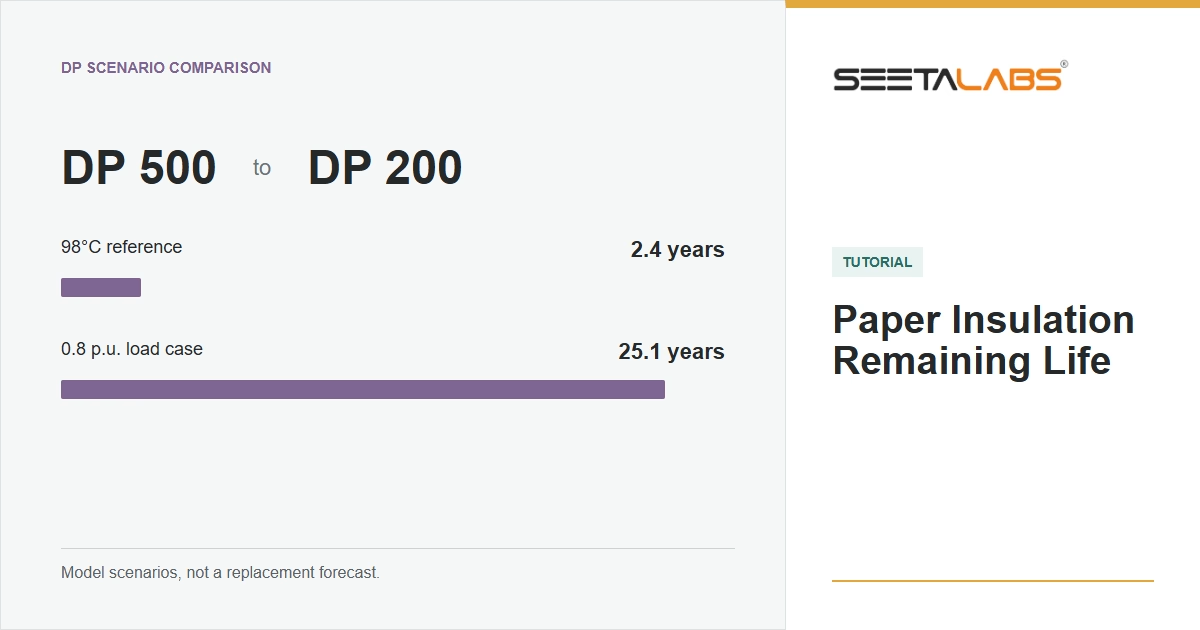
A result of 2.4 years can sound like a replacement deadline. In a paper-ageing calculation, it may instead mean that a specified starting degree of polymerisation reaches a chosen endpoint if the paper remains at 98 degrees C under one fixed moisture condition. That is a much narrower statement.
The useful question is not simply how many years the software displays. It is what starts the calculation, what conditions continue into the future and what the endpoint represents.
On this page (6 sections)
Keep measured condition, inferred condition and scenarios separate
Degree of polymerisation, or DP, characterises cellulose chain length. A DP measurement belongs to the sampled paper. A correlation from 2-furfural, usually reported as 2-FAL, produces an estimated DP rather than a direct paper measurement.
For further reading, see CIGRE's review of solid insulation condition. DP 200 is a modelling endpoint here, not a guarantee of failure at that number or safety above it.
Seetalabs® Paper Insulation Remaining Life version 1.1.6 (October 2026) follows three distinct paths. Measured DP takes priority as the scenario starting point. Without it, a supplied age allows a model-based reconstruction from a new-paper DP of 1000, the starting value used in IEC 60076-7 Annex A. Furans remain a separate estimated-DP result and trend. They never become the starting DP for the year calculation, even when age is also entered.
An age-derived starting condition therefore carries an additional assumption: the model applies the chosen thermal and environmental conditions over the elapsed age. It has not reconstructed the actual operating history from a nameplate date.
Moisture and oxygen are not interchangeable sliders
The tool uses discrete conditions from IEC 60076-7:2018 Annex A, Table A.1: free from air at 0.5, 1.5 and 3.5 percent paper moisture, and with air at 0.5 percent. It does not interpolate a new combined moisture-and-oxygen condition between those entries.
For an entered moisture of 1.8 percent, the software brackets the calculation with the 1.5 and 3.5 percent conditions. The resulting spread is a comparison of model conditions, not a statistical confidence interval.
The preservation selection determines how air exposure is represented. Selecting sealed is a modelling assumption about the applicable condition, not evidence that an operating transformer's insulation is oxygen-free. The dissolved oxygen concentration entered from DGA is informational: changing that concentration alone does not change the computed scenario.
For a free-breathing selection, the software adds the with-air condition and reports only a model-derived upper bound, with no lower bound. It does not synthesise the missing combination of high moisture and air. The same one-sided treatment applies when moisture exceeds the highest available no-air condition. Neither output is a validated bound on actual service life.
A reference case that can look alarming
Consider a synthetic mineral-oil transformer with kraft paper, age 30 years, the sealed preservation setting, measured DP 500 and paper moisture entered as 1.5 percent. Use the IEC ageing basis, endpoint DP 200 and no load profile.
The software then uses its constant 98 degrees C reference case, with relative ageing rate V equal to one. The chain-scission rate for this condition is approximately 1.424904 x 10^-7 per hour in reciprocal-DP terms. The scenario calculation is:
years = (1/200 - 1/500) / (1.424904e-7 x 8760) = 2.4034
The entered age does not subtract another 30 years from this result. Measured DP already supplies the starting condition, and the calculation proceeds from that value.
The result says what the model does under continuous reference conditions. It does not say that the transformer will fail in 2.4 years. Nor does V = 1 mean zero ageing: it identifies the reference rate.
Replace the reference temperature with an explicit duty
Keep the same measured DP, moisture and preservation assumptions. Now specify ONAN cooling, rated top-oil rise of 52 K, rated hot-spot gradient of 26 K, loss ratio R of 6, constant load of 0.8 per unit and ambient temperature of 20 degrees C.
The IEC calculation in the tool produces a hot spot of approximately 78.16 degrees C and a scenario of about 25.06 years to DP 200. The reference case remains about 2.4 years. Nothing has repaired the paper between those two calculations; the assumed continuing thermal duty has changed.
This comparison is useful precisely because the outcome is sensitive to duty. It is not evidence that operating any transformer at 0.8 per unit provides 25 years of service. The result depends on the entered heat-run quantities, cooling model, ambient temperature, starting DP and continued environmental assumptions.
Without the required heat-run quantities, the page states that your load case is not computed. The reference case can still appear, so a report must identify which case it is quoting.
What the furan example does, and does not, establish
In a separate kraft-paper case, enter 2-FAL of 0.3 mg/kg on 1 May 2020 and 1.5 mg/kg on 1 May 2026, with neither measured DP nor age. The tool's IEEE C57.140-2017 correlations return approximately DP 381, 625 and 684 for the latest sample. The selected model is Pahlavanpour at about 625; the spread is 381-684.
That spread reflects disagreement among correlations. It is not a measured spatial range of DP within the windings or a confidence interval. The selected correlation changes from approximately 758 to 625 over the dated samples, giving an inferred decline of about 22 DP per year. This is not a directly measured chain-length loss rate and must not be projected into a countdown.
No scenario years are returned for this furan-only case. Adding age enables a separate age-based calculation; it does not promote the furan estimate into a measured baseline.
The tool preserves a result such as "<0.05" as censored, including the limit, rather than treating 0.05 as a measured concentration. With a censored latest result, it displays no central DP estimate; with a censored trend endpoint, it does not calculate a DP-per-year trend. An unknown limit or one below 0.05 ppm, outside the model range, produces no furan-based DP estimate. Where it displays a lower bound, that value is the lowest DP given by the paper-relevant IEEE C57.140-2017 correlations at the reported limit, because each correlation falls as 2-FAL rises. For kraft paper and "<0.05", the displayed bound is DP at least 793. It is not a measured minimum DP or a validated bound on the real paper condition. Preserve the laboratory qualifier and check model applicability. Censored furans still do not supply a baseline for years remaining.
Scope and limitations
The public IEC 60076-7:2018 scope addresses mineral-oil-immersed transformers, temperatures and thermal ageing. IEEE C57.140-2017 is listed as active and covers evaluation and reconditioning.
These examples use the Table A.1 coefficients and Equations (2) and (A.2) of IEC 60076-7:2018, and the paper-relevant correlations in Equations 7 to 10 of IEEE C57.140-2017. IEC 60076-7 itself describes the Table A.1 results as unconfirmed and disputable, so the scenarios remain model comparisons. Aramid is outside the model. Non-mineral liquids receive a mineral-oil-data warning, not a validation for ester or silicone insulation systems.
Use the calculation to compare explicit assumptions and identify missing evidence. It does not certify an asset's condition, prescribe replacement or quantify the life of bushings, tap changers and other components. Keep the measured data, inferred DP and conditional years visibly separate.
Compare explicit scenarios in Paper Insulation Remaining Life.