What should I check when the Duval Triangle and Duval Pentagon give different results?
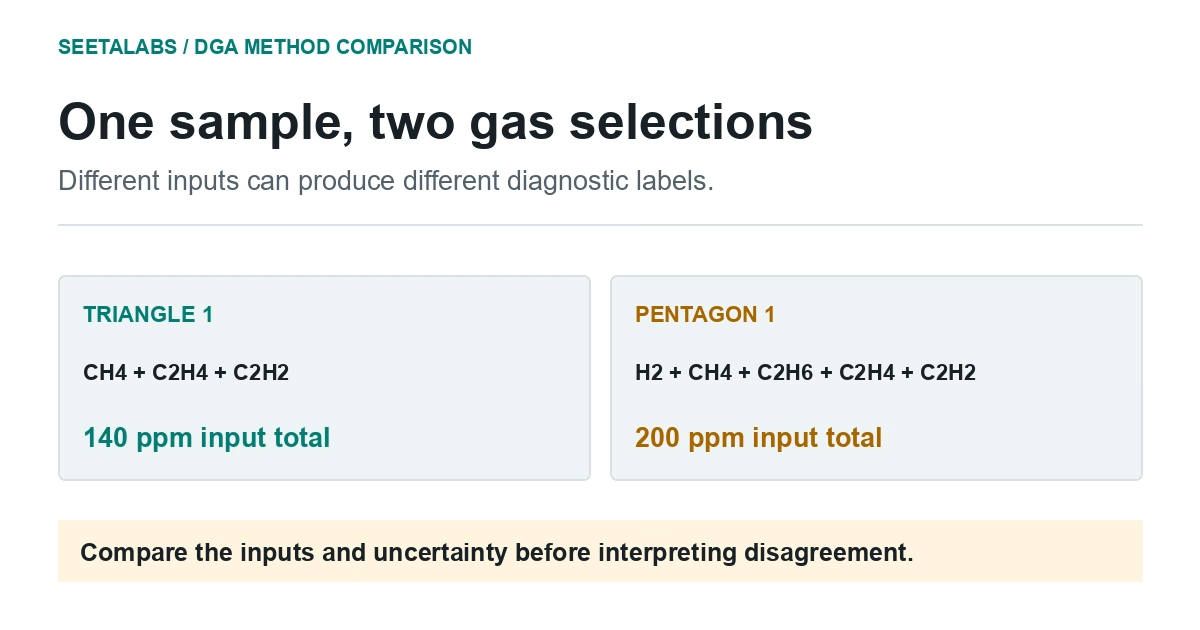
First check that both calculations used exactly the same report, compartment, fluid, units and qualifiers, because Triangle 1 uses methane, ethylene and acetylene while Pentagon 1 also adds hydrogen and ethane. A disagreement can come from an input error, boundary sensitivity, a new gas pattern over an older background or more than one active process. Neither the more alarming label nor a majority vote settles it, because the methods share gases.
A Duval Triangle and a Duval Pentagon can disagree while both calculations are correct. Check the sample, method and gas inputs before interpreting the different labels. Choosing the more alarming label or taking a majority vote does not resolve the difference.
This article concerns a mineral-oil main-tank sample. The basic Duval Triangle method is explained separately.
1. Check whether the comparison is valid
Use exactly the same report in both calculations. Confirm sampling date, identifier, compartment, units and fluid. Check whether either program selected an older result or converted a below-detection value to zero.
Identify the methods. Triangle 1 and Pentagon 1 provide an initial comparison; a refinement may answer another question. CIGRE TB 771 (2019), Appendix H.4, discusses their relationship with thermal refinements.
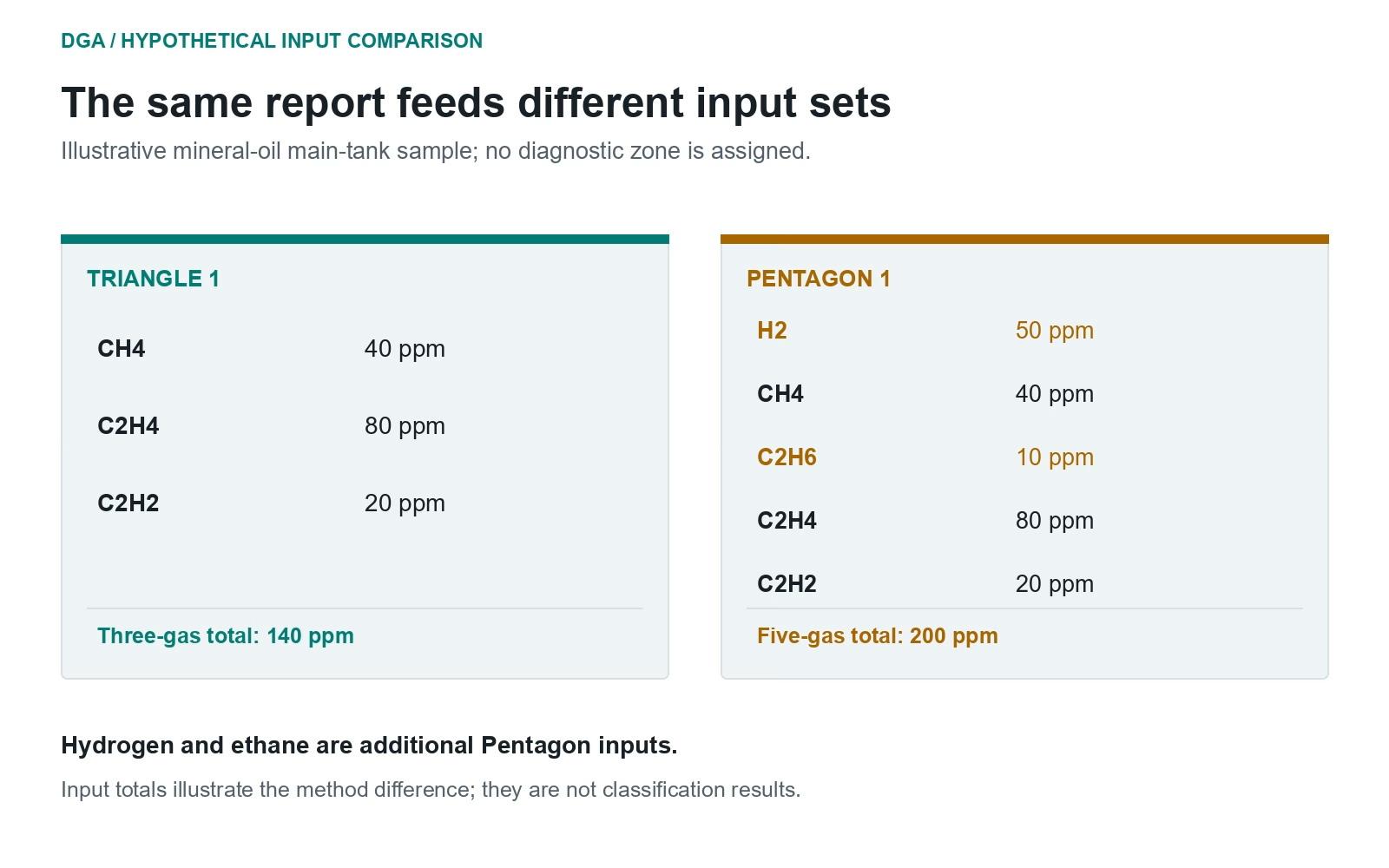
Triangle 1 uses methane, ethylene and acetylene; Pentagon 1 adds hydrogen and ethane. An incorrect hydrogen result can change the Pentagon while leaving Triangle 1 unchanged. Check decimal places, column mapping, rounding and qualifiers, consistent with the data-quality review in IEEE C57.104-2019, Clause 5.1.
For example, take H2 50, CH4 40, C2H6 10, C2H4 80 and C2H2 20 ppm. Triangle 1 normalizes its three inputs against 140 ppm; Pentagon 1 uses all five, totaling 200 ppm. These totals illustrate the input difference. They do not assign a diagnostic zone.
2. Use disagreement to narrow the investigation
| Possible explanation | What would support it? | Useful next check |
|---|---|---|
| Input mismatch | Different gas values, dates or qualifiers | Recalculate from one preserved report |
| Wrong method family | Ester or OLTC sample assessed as mineral main tank | Verify fluid and compartment |
| Boundary sensitivity | Small justified input changes alter a label | Evaluate results across measurement uncertainty |
| Hydrogen or ethane contribution | These gases dominate the difference between representations | Review their accuracy and individual histories |
| Historical and recent gas mixed together | A new gas pattern develops over an old background | Review comparable sample increments |
| Multiple active processes | Persistent disagreement with independent corroboration | Plan tests that distinguish the competing hypotheses |
CIGRE TB 771, Appendix H.6, explains that disagreement can suggest mixed faults. It does not establish the number or location of physical defects.
Multiple methods share gases and evidence; they are not independent votes. A majority can conceal sensitivity to a gas omitted by another method.
3. A hypothetical disagreement near a boundary
Suppose validated implementations give different categories from one confirmed mineral-oil main-tank report. One graphical point lies close to a zone boundary.
Use the laboratory's gas-specific uncertainty to choose documented input combinations, accounting for known correlations. If some combinations cross the boundary, the result is sensitive in those tested scenarios. This gives no fault probability. A few unchanged outputs do not prove universal stability.
If categories remain different throughout the test and comparable samples show new acetylene over an older thermal pattern, investigate an evolving mixture. Check contamination, oil communication and operating events.
Record the varied gases and changed outputs. This exercise is engineering guidance, not a standard-prescribed confidence calculation.
4. Record the unresolved question, then act on evidence
Preserve the gas vector and both method versions. Suspected hydrogen loss calls for sampling and laboratory checks. Align a new gas contribution with comparable samples and event dates. A confirmation sample tests reproducibility, not defect location; the specialist selects further investigations.
Record both interpretations and their limits in the DGA assessment. Agreement alone does not prove a fault or authorize an operating decision.
References: CIGRE TB 771 (2019), Appendix H.4 and H.6, pp. 69-70; IEEE C57.104-2019, Clause 5.1. Relevant licensed passages checked as of 25 September 2026. The review table and hypothetical sensitivity exercise are original, not standard decision rules.