Does a PCB concentration result alone settle a transformer’s compliance obligations?
No. Obligations depend on concentration, liquid volume, equipment status, analytical method and jurisdiction. Under Regulation (EU) 2019/1021, equipment above 0.005% PCB and above 0.05 dm3 must be identified and removed from use no later than 31 December 2025, while 40 CFR 761.3 places 50 ppm or more but below 500 ppm in the PCB-Contaminated Electrical Equipment category. Keep the unrounded reported value, unit and method, and ask the laboratory about uncertainty near a threshold.
A fleet spreadsheet can list PCB concentrations without showing which units need analysis, which deadlines have passed or what documentation is missing. Seetalabs® PCB Compliance Triage brings those questions into one inventory assessment. Enter the equipment and laboratory data, select a rule profile, and examine the classes, duties, dates and possible treatment or disposal routes in the dossier.
This walkthrough follows version 1.0.3 (October 2026) and a worked transformer example. The tool organises supplied data; it does not detect PCB, predict contamination from DGA or certify compliance. Site-specific decisions still need the applicable law, competent review and reliable asset records.
On this page (8 sections)
- 1. Set the country, rules and assessment date
- 2. Build the inventory one unit at a time
- 3. Select the laboratory method correctly
- 4. Follow a transformer from input to result
- 5. Read the summary and the full dossier
- 6. Investigate boundary and indeterminate results
- 7. Compare the proposed routes without treating them as approval
- 8. Save the inventory and retain the evidence
1. Set the country, rules and assessment date
Start with Country of the site. The tool selects its associated profile: European Union, United States or the Stockholm Convention baseline, with country-status notes. This is a profile selector, not a database of every national rule. A manual jurisdiction change produces a notice; it does not change which law applies to the site.
Set Assessment date explicitly when reproducing a case. It controls whether fixed deadlines appear overdue. It does not retrieve the law historically in force on that date: the tool uses its included rules. The built-in inventories are fictional examples, not customer records.
2. Build the inventory one unit at a time
Use Add unit for each item. Enter its tag, equipment type, PCB result, laboratory method, liquid quantity in litres or kilograms, and status: in service, stored for reuse, or out of service/waste. Equipment options include transformers, capacitors and other liquid-filled equipment. An untested unit should use Never analysed, not a fictitious zero concentration.
Open Details to check fluid type, year built, condition and retrofill history. Capacitors can share a bank tag; the EU calculation aggregates their liquid volumes by bank. Additional US fields describe installation and exposure conditions. The default mineral oil and checked good-condition setting are assumptions to confirm, not findings from an inspection.
Match each entry to the original laboratory report and sampled compartment. Keep sampling dates, qualifications and subsequent servicing in the supporting file: not all of that evidence has a dedicated tool field. Resolve input errors before relying on the dossier, even if results remain visible.
3. Select the laboratory method correctly
For a mass fraction, 1 mg/kg equals 1 ppm by mass. Neither is automatically interchangeable with mg/L. Ask the laboratory to clarify an ambiguous result rather than choosing the unit that puts the asset below a threshold.
The analytical method matters. EN 12766-2:2001, section 4.2.1, estimates PCB content in Method B by multiplying the sum of six specified congeners by five. These are PCB 28, 52, 101, 138, 153 and 180. The factor represents an average relationship, not a sample-specific determination of every congener.
For a synthetic six-congener set of 1, 2, 3, 2, 3 and 2 mg/kg, the sum is 13 mg/kg and the Method B estimate is 65 mg/kg. If the report already states the calculated Method B result, enter 65, not five times 65. An arbitrary seven-congener sum is not this method. The engine leaves other congener sums indeterminate and does not use Method B to assign its US classification. These are software safeguards, not confirmation that a particular report meets every jurisdiction's analytical requirements.
4. Follow a transformer from input to result
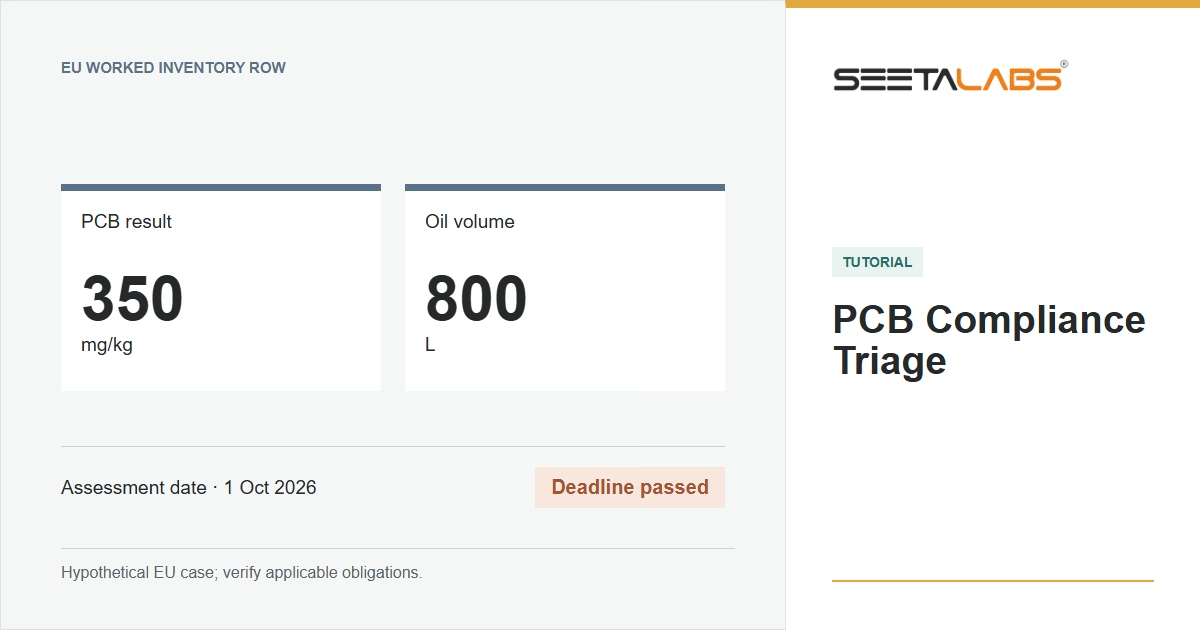
Use a hypothetical mineral-oil transformer still in service, with 800 L of oil and a reported total PCB concentration of 350 mg/kg by IEC 61619. The assessment date is 1 October 2026. No retrofill history is entered.
For the EU walkthrough, choose Italy, tag the row TR-EXAMPLE, select Transformer, enter 350, choose Total PCB, IEC 61619, enter 800 litres and select In service. In Details, confirm mineral oil. This creates one assessment row; it does not require loading the multi-unit demonstration inventory.
The engine returns S3 for its Stockholm profile, E3 for the EU profile and U5 for the US profile. These identifiers belong to the software; they are not statutory category names. Running all three illustrates their different questions. It does not allow the owner to choose the least restrictive result.
For the EU, the PCB entry in Annex I of Regulation (EU) 2019/1021 covers equipment above 0.005% PCB and above 0.05 dm3. That volume is 0.05 L, not 0.5 L. It requires Member States to identify such equipment and remove it from use as soon as possible, and no later than 31 December 2025. The example exceeds both thresholds, so the tool marks that date overdue. Consolidated Regulation, Annex I.
Directive 96/59/EC also contains provisions for transformers between 0.005% and 0.05% PCB, including end-of-useful-life disposal. Displaying that provision alongside the Regulation does not establish permission to ignore the 2025 requirement. Resolve the site's applicable obligations and corrective action with its compliance specialist and competent authority. Directive, Article 9.
The US definition places equipment at 50 ppm or more but below 500 ppm in the PCB-Contaminated Electrical Equipment category; a PCB Transformer contains 500 ppm or more. Write the first range as 50 <= C < 500, not "50-499": laboratory results need not be whole numbers. Classification alone does not settle use restrictions or disposal requirements. 40 CFR 761.3.
The Stockholm profile reflects treaty priorities addressed to Parties. Its 2028 waste-management objective is not permission to operate until 2028, nor a substitute for national requirements. Convention, Annex A Part II.
5. Read the summary and the full dossier
The Live summary counts assessed units and units past a deadline, estimates PCB mass and shows the next dated deadline. In the single-unit EU example, one unit is assessed and one is overdue. The full dossier adds the class distribution, deadline timeline, per-unit duties and routes, paperwork, analytical cautions and sources. A Next dated deadline shown as "none" does not mean there are no obligations: a requirement may be relative or already overdue.
The engine assumes a mineral-oil density of 0.87 kg/L. For this example:
Oil mass = 800 L x 0.87 kg/L = 696 kg
Estimated PCB mass = 696 kg x 350 mg/kg / 1,000,000 = 0.2436 kg
The mass calculation gives 0.2436 kg before display rounding; the summary shows about 0.24 kg. This estimates PCB in the recorded liquid, not the mass of contaminated equipment or PCB retained in paper. The density is a software assumption, so compare it with the documented fluid data when preparing the actual inventory. Neither calculation validates the sample.
6. Investigate boundary and indeterminate results
Changing the example to exactly 50 mg/kg changes the software's in-service outputs to S5, E2 and U5. Marking the same row as waste instead produces S6, E9 and U11. Equipment status is therefore an input with consequences, not a label to change for a favourable result.
The EU waste limit in Annex IV is 50 mg/kg. Article 7's below-limit exception is not an at-or-below exception; other specified derogations have their own conditions. A lower classification does not remove other waste-law duties. Regulation, Article 7 and Annex IV.
Near a threshold, preserve the unrounded reported value and ask the laboratory about uncertainty and the relevant decision rule. The engine's grey-zone flag uses a reproducibility-based heuristic. It is not the laboratory's expanded uncertainty or a legal confidence interval. Absence of a flag is not evidence of certainty: its Method B reproducibility lookup has a limited concentration range.
7. Compare the proposed routes without treating them as approval
The per-unit dossier can show a retrofill route, a disposal route, or a request for analysis first. Read the prerequisites, warnings and source references, not only the eligibility badge. Disposal outputs describe the selected profile's operations and timing; they do not appoint a contractor, issue a permit or price the work.
For a separate hypothetical unit initially at 400 mg/kg, the engine's first-cycle estimate is 0.10 x 400 = 40 mg/kg. Its basis is the approximate retention discussion for distribution transformers in UNEP's 2002 PCB management guidance, section 9.4.4. This is an illustrative planning assumption, not a guaranteed treatment outcome or a validated estimate for every power transformer.
US reclassification conditions depend on both initial and replacement-fluid concentrations. Under 40 CFR 761.30(a)(2)(v), the route for an initial concentration of at least 1,000 ppm, or untested fluid, includes 90 continuous days operating under load followed by testing. A separate route for initially 50 to below 500 ppm with replacement fluid below 2 ppm does not require that test. The full conditions and records still apply. 40 CFR 761.30.
The tool asks for the sampling date, replacement-fluid concentration and confirmation of loaded operation where required by its selected profile. Entering a retrofill date alone does not establish reclassification. In the US worked variant with 400 mg/kg before retrofill, 40 mg/kg afterwards, retrofill on 1 June and assessment on 1 October 2026, missing sample and replacement-fluid evidence retain U5 and show U14 only as a "Conditional result". The "No blocking condition found" badge is not an authorisation. These fields record supplied assertions; they do not authenticate laboratory reports or operating records.
The EU profile uses an Irish procedural reference alongside the Directive, not a verified procedure for every Member State. The Irish EPA guide describes post-retrofill testing after at least 90 days of operation. Its current download also carries a cover warning: legislation introduced after the guide was written requires qualifying equipment to be removed from use by 31 December 2025. Do not read the body's older end-of-useful-life language as permission to continue operating. Check national requirements and the applicable records before accepting the outcome; a candidate treatment cannot erase an already missed removal deadline. Irish EPA guide, cover and printed pages 18 and 20.
8. Save the inventory and retain the evidence
Use Save inventory to download the tool's JSON file, and Open saved file to resume it. This is not an importer for arbitrary laboratory PDFs or spreadsheets. The dossier's print button opens the browser print dialogue, where PDF output depends on the browser's available destinations. Retain both the editable inventory and a dated assessment record: reopening an inventory recalculates it rather than preserving a signed result.
The tool calculates in your browser and sends nothing you enter over the network. It loads its files and fonts from the website. It does not automatically retain the inventory across sessions. Save deliberately and handle downloaded files according to the site's information policy.
Keep the laboratory reports, servicing evidence and reviewer decisions alongside the inventory. The tool's source list makes its reasoning easier to inspect, but does not establish that national rules or later amendments have been incorporated.
The useful output is a reviewable case file. A colour, class code or estimated concentration is only one part of it. This example is technical guidance for organising that file, not site-specific legal advice or an instruction to continue operating contaminated equipment.
Assess your own inventory in PCB Compliance Triage.