How do I estimate the 2026 CBAM certificate cost for imported steel?
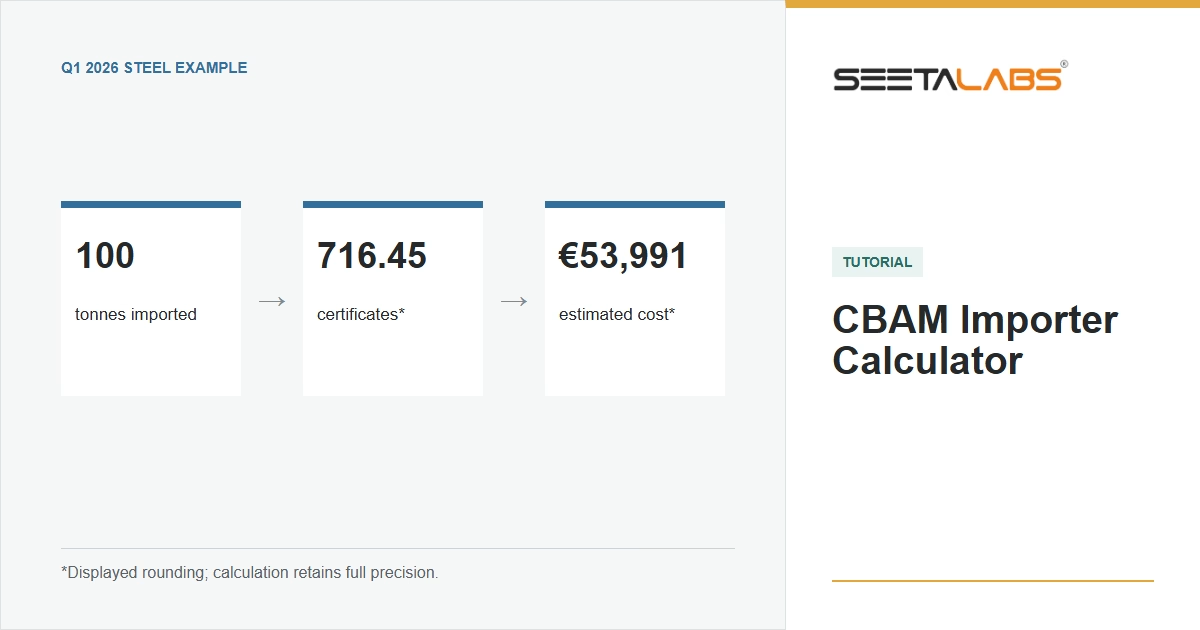
Subtract the specific embedded free allocation from the specific embedded emissions, multiply by tonnes, then by the quarterly certificate price. Without verified supplier data, use the default value from Implementing Regulation (EU) 2025/2621, corrected by 2026/1740, with the 10 percent mark-up for 2026, and take the free allocation as benchmark column B x CBAM factor x CSCF. For 100 t of CN 7225 11 00 from China in Q1 2026, that gives 716.4475 certificates.
For EU importers, the 2026 CBAM question is not only whether a CN code is covered. It is how tonnes, origin, default values, mark-ups, free allocation and quarterly certificate prices combine into a budget and a declaration workflow.
The worked example uses Seetalabs® CBAM Importer Calculator version 1.3.4 (October 2026).
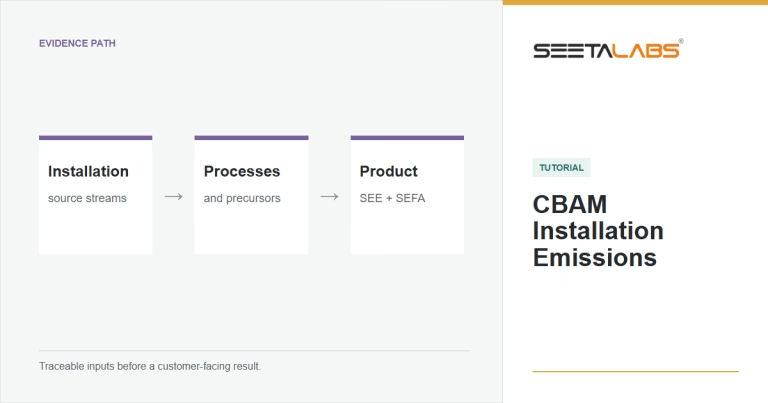
Keep three records separate: the customs entry, the emissions evidence and the calculation version. A product description such as "electrical steel" is not enough to select the applicable row. A supplier's corporate carbon footprint is not automatically the specific embedded emissions of the goods imported.
On this page (6 sections)
Check the Scope Before the Cost
Confirm classification and origin before choosing an emissions factor. For the mass-based exemption, the Commission's Guidance No. 1 explains that the 50-tonne threshold is cumulative per importer and calendar year, not an allowance deducted from each shipment. Once exceeded, the year's covered imports are included, not only the excess. That exemption does not apply to hydrogen or electricity. The worked steel example below assumes the importer is subject to CBAM.
Method
Start from the CN or TARIC code, origin country, tonnes and quarter. Without verified supplier data, use the default value for the country and product line from Implementing Regulation (EU) 2025/2621, corrected by Implementing Regulation (EU) 2026/1740. If the table has a more specific TARIC line, use that line. If the country is absent, or its relevant value is missing or shown as a dash, use the respective good in "Other countries and territories".
For cement, iron and steel, aluminium and hydrogen, default values carry a mark-up of 10 percent in 2026, 20 percent in 2027 and 30 percent from 2028. Fertilisers carry 1 percent from 2026. These Annex I rules do not describe the separate electricity defaults. Verified actual emissions replace defaults without mark-up.
Use the corrected table's total-emissions column as the starting value. Do not reconstruct it by adding the displayed direct and indirect columns: those are informational, and rounding can make their sum differ from the total. The correction removes the precomputed yearly mark-up columns; recital 10 explains that the Registry calculates the final marked-up values. Retain the base value and mark-up separately in the calculator's evidence trail.
For iron and steel, the emissions scope depends on the goods: CN chapter 72, except the ferro-alloys excluded from Annex II of Regulation (EU) 2023/956, and the listed headings 73xx count direct emissions only. Agglomerated iron ores (2601 12 00) and those excluded ferro-alloys count direct and indirect emissions. Do not apply a direct-only rule to the entire sector.
The specific embedded free allocation (SEFA) is:
CBAM benchmark column B x CBAM factor x CSCF
That is Equation 6 of Implementing Regulation (EU) 2025/2620; Equation 1 then multiplies the SEFA by the tonnes to give the free allocation adjustment. The default-value approach is explained in section 2.2.1.2 of the Commission's Guidance No. 4. For the 2026 example, the CBAM factor is 97.5 percent and the cross-sectoral correction factor (CSCF) is 100 percent. Column B already incorporates relevant precursors; do not add their allocation a second time. An actual-data calculation uses a different evidence route and must not silently reuse the default calculation's assumptions.
Certificates are:
max(0, specific embedded emissions - SEFA) x tonnes
Here both terms inside the brackets are specific quantities in tCO2e per tonne of the same good. This simplified budget calculation excludes any eligible carbon-price deduction and assumes no special customs procedure. It is not a complete declaration rule for every import.
Worked example
An EU importer brings in 100 t of grain-oriented electrical steel sheet, CN 7225 11 00, from China in Q1 2026, with no verified supplier data.
| Step | Value |
|---|---|
| Default total emissions, route C | 8.09 tCO2e/t |
| 2026 mark-up | 10 percent |
| Marked-up value | 8.899 tCO2e/t |
| Benchmark column B | 1.779 tCO2e/t |
| Specific embedded free allocation (SEFA), retained precision | 1.734525 tCO2e/t |
| Certificates, retained precision | 716.4475 |
| Certificates, displayed to two decimals | 716.45 |
| Q1 2026 price | 75.36 EUR |
| Estimated cost | 53,991.48 EUR |
The corrected Annex I China row for CN 7225 11 00 gives total emissions of 8.090 tCO2e/t and route C, the BF/BOF carbon-steel benchmark route. Its direct-emissions value is also 8.090; indirect emissions are marked N/A. Use the table's route indicator to select the corresponding benchmark, not a route guessed from the product description.
The arithmetic is 1.779 x 0.975 = 1.734525, then (8.899 - 1.734525) x 100 = 716.4475. Multiply that unrounded result by EUR 75.36 to obtain EUR 53,991.4836, displayed as EUR 53,991.48. Multiplying the displayed 716.45 instead produces EUR 53,991.67. Retain precision through the calculation and document the final reporting convention; this example does not prescribe Registry rounding.
Holding the base emissions and the SEFA fixed, the mark-up contributes 8.09 x 0.10 x 100 = 80.9 certificates. That isolates one component of this default-value calculation; it is not a guaranteed saving from obtaining supplier data. Verified actual emissions can differ from the default, and the associated allocation evidence can change. Compare the two complete calculations before quoting any saving.
Dates
As at 15 October 2026, the Commission's certificate-price page lists EUR 75.36 for Q1 2026, published on 7 April, EUR 75.28 for Q2, published on 6 July, and EUR 82.32 for Q3, published on 5 October. The Q4 price is scheduled for 4 January 2027; from 2027 the Commission publishes the price every week. For a quarter whose price is not yet published, the calculator uses the latest published price, currently Q3's EUR 82.32, and marks it as an estimate. Do not present that estimate as the published price for Q4. Purchases on the common central platform begin in February 2027. Guidance No. 1 gives 30 September 2027 as the first annual declaration deadline, covering 2026 imports.
For the 2026 imports in this example, certificate sales start on 1 February 2027 and both the declaration and surrender are due by 30 September 2027. These dates follow Articles 20(1), 6(1) and 22(1) of Regulation (EU) 2023/956 as amended by Regulation (EU) 2025/2083.
Repurchase is a request, not an automatic refund. Article 23 sets a 31 October deadline in the year of surrender and limits the quantity eligible under its ordinary rule to the number required to be purchased under Article 22(2) during the purchase year. It also provides an exception for declarants who bought certificates expecting to exceed the mass threshold but did not. Certificates bought in 2027 for 2026 emissions can be repurchased only in 2027 under Article 23(2a). Do not read the calculator's deadline reminder as confirmation that every surplus certificate qualifies.
Cancellation has two clocks. Under Article 24(2), certificates remaining for 2026 emissions are cancelled without compensation on 1 November 2027. Under the ordinary rule in Article 24(1), cancellation on 1 November concerns certificates bought two calendar years earlier and still on account: for example, a certificate bought in 2028 for later emissions reaches that date in 2030, not 2029. The purchase year, not merely the import year, matters. Article 24(3) suspends cancellation for the amount disputed in pending proceedings in a Member State.
Keep the purchase year and emissions year beside each certificate balance. The tool's later-year reminder names certificates bought in the selected year; it is not a reconciliation of an account containing purchases from several years.
Limits
The Commission's legislation index lists COM(2025) 989 as a proposal concerning downstream goods. Do not turn a proposed 2028 inclusion into a current liability. Check the exact CN or TARIC line, including any partial "ex" scope, rather than treating every transformer under heading 8504 as covered. The calculator's proposal check is not a certificate-cost calculation for those proposed goods.
The Seetalabs® supplier data file is a provisional interchange format, not an official Registry submission. Check the Commission's current template and reporting requirements before relying on it. A file that opens successfully is not proof that its contents were verified.
Keep the Evidence Beside the Number
For each line, retain the customs identifier, net mass, origin, import quarter, factor source and version, selected production route, emissions basis, allocation calculation and price source. If supplier evidence replaces a default, preserve both versions and record why the replacement is admissible. Missing evidence should remain visible rather than disappear into a convenient zero.
This article supports calculation review, not legal or tax advice. Official Journal texts and decisions of the competent authorities prevail over guidance, software output and this worked example.
Calculate your case in the CBAM Importer Calculator. See all free engineering tools.