What CBAM data should a non-EU producer provide to an EU customer?
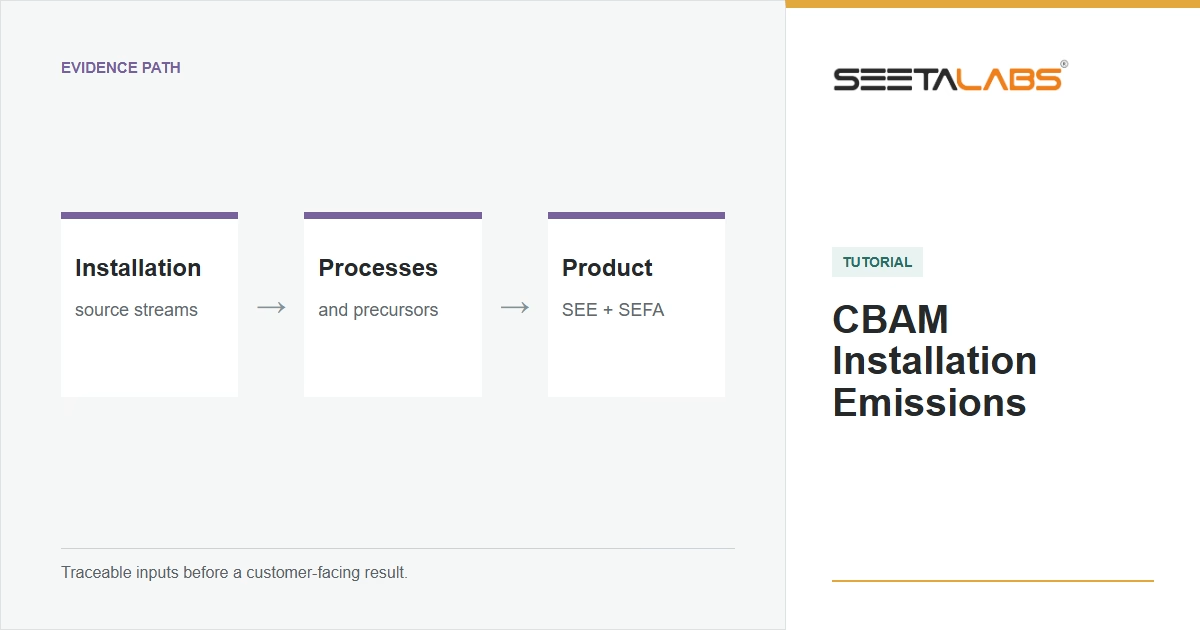
The customer needs product-level specific embedded emissions and specific embedded free allocation, calculated so that the customer and verifier can trace them. Implementing Regulation (EU) 2025/2547 gives the calculation structure, and free allocation uses Implementing Regulation (EU) 2025/2620. Attach installation and product identifiers, reporting period, production quantity, source-stream records, factor references and precursor evidence, and mark a missing electricity factor as not evaluated rather than zero.
When an EU customer asks a non-EU producer for "CBAM data", the useful answer is not a brochure. It is product-level specific embedded emissions and specific embedded free allocation, calculated in a way the customer and verifier can trace.
The examples use Seetalabs® CBAM Installation Emissions Calculator version 1.4.3 (October 2026).
Start with the production boundary, reporting period and product identity. Keep measured quantities, selected factors and calculated outputs distinguishable. If several products share a process, an installation total divided by the most convenient production figure is not an adequate attribution method.
Method
Implementing Regulation (EU) 2025/2547 gives the calculation structure. Emissions of the installation can come from combustion, process emissions and mass balance, using the equations in Annex II.
A continuous emissions measurement system (CEMS) is not an interchangeable input option. Annex II B.6.1 requires it for N2O; for CO2, there must be evidence that it provides more accurate data than a calculation-based method. Section B.6.2.6 allows an hourly or shorter-period average to be calculated pro rata from the remaining data points only where at least 80% of the maximum number of data points for the parameter is available. Below that threshold, substitution rules apply, not a zero emission entry. CO2 measurements also need the corroborating annual calculations in B.6.4.
If you enter only an annual total, the tool cannot perform these checks. With hourly values it applies the substitution of Equation 19 to hours below the coverage threshold, flags hours without a flue-gas volume and compares the result with the corroborating calculation you enter.
For CO2 transferred to storage or permanent chemical bonding, B.8.2 requires evidence across the custody chain, including transport, of the fraction actually stored or bound. A transfer quantity alone is not the deduction. Keep the receiving-party records and monitoring evidence required by B.8.3 with the calculation.
For production processes, Annex III supplies the attribution and product calculations, including Equations 55 to 63. The Commission's Guidance No. 3, section 4.2.2, explains the distinction: complex goods include the embedded emissions of relevant precursors before normalising by the activity level. Keep the functional unit explicit; it is not always simply one tonne of finished product.
Free allocation uses Implementing Regulation (EU) 2025/2620. Column A concerns process steps in an actual-data calculation; relevant precursor allocation must be included. Column B is used for the default-value route and already covers the corresponding chain. The distinction is explained in Guidance No. 4, section 2.2.1.3. Keep values before and after annual factors separately labelled; applying the factors twice understates the adjustment.
Electricity needs special care. The tool does not include an IEA grid-factor table. The user enters either the default grid factor from Annex II of Implementing Regulation (EU) 2025/2621 or a documented actual factor allowed by Implementing Regulation (EU) 2025/2547. Without a factor, indirect electricity emissions are not evaluated, not treated as zero.
For electricity consumed in making goods, Annex II D.4.3 specifies evidence for actual indirect emissions: a direct technical link or a qualifying physical-delivery power purchase agreement, supported by generation and delivery measurements matched within periods no longer than one hour. The applicable route requires its own connection and contractual evidence. A supplier's advertised carbon factor alone does not establish eligibility. Do not confuse these requirements with D.2.4, which concerns electricity itself imported into the EU.
Worked examples
The Commission's hydrogen example in Guidance No. 5b, section 4, uses 190,000 t of natural gas as feedstock and fuel, 48 GJ/t, 56.1 tCO2/TJ, 800 TJ of exported heat and 55,000 t of hydrogen. It assumes 2028 and a 90% boiler reference efficiency for the heat calculation.
Reproduce the arithmetic without rounding the heat factor first: 190000 x 48 / 1000 x 56.1 = 511632 tCO2; heat deduction 800 x (56.1 / 0.90) = 49866.6667 tCO2; net divided by 55000 gives about 8.395733 tCO2/t.
| Result | Value |
|---|---|
| Specific embedded emissions | 8.396 tCO2e/t hydrogen |
| Specific embedded free allocation, 2028, with factors | 4.580 tCO2e/t |
| Illustrative certificates for 100 t in 2028, using the guidance's rounded values | 381.6 |
The guidance uses 5.089 x 0.90 = 4.5801, displayed as 4.580. Its displayed-value calculation is (8.396 - 4.580) x 100 = 381.6, before any eligible foreign carbon-price deduction. A full-precision result is approximately 381.56. These are illustrative quantities, not a euro cost or a facility prediction.
Steel rails imported in 2027, from Example 1 (integrated steel works) in section 4.1 of the Commission's Guidance No. 5d: free allocation is chained through sinter, pig iron, crude steel and rails. The resulting specific embedded free allocation is 1.26105 tCO2e/t without factors and 1.19800 tCO2e/t with the 2027 factors. The guidance is listed in the Commission's CBAM legislation and guidance index.
Before annual factors, the chain is 1.089 + 1.4 x 0.086 = 1.2094 for pig iron, 0.188 + 0.8 x 1.2094 = 1.15552 for crude steel, then 0.057 + 1.042 x 1.15552 = 1.26105184 for rails. The 2027 CBAM factor of 95% and a cross-sectoral correction factor (CSCF) of 100% give 1.26105184 x 0.95 = 1.197999248, which the guidance shows as 1.261 and 1.198. These values do not by themselves establish certificates due.
Keep precursor quantities and their per-unit allocation evidence with the chain. Keep direct and indirect precursor emissions separate, as required by Annex II A.1(5) of Implementing Regulation (EU) 2025/2547. Do not include precursor allocation twice, or mix factors from different reporting periods without checking the applicable rule. A total that includes indirect emissions is not automatically the emissions basis required for the final imported good.
What the Customer Needs with the File
Attach a traceable explanation, not only a result column: installation and process identifiers, product code, reporting period, production quantity and unit, source-stream records, factor references, attribution method and precursor evidence. Identify which figures are actual, default, calculated or not evaluated. Keep verification scope and report references separate from a software validation message.
If an example or guidance value differs from your calculation, first check units, boundaries and retained precision. Record the discrepancy and obtain a technical resolution before replacing it. Agreement with an example does not establish that every legal requirement has been met.
Limits
Calculation is not accredited verification. Implementing Regulation (EU) 2025/2546 sets out the principles for verifying declared embedded emissions; Delegated Regulation (EU) 2025/2551 sets the conditions for accrediting verifiers and for their oversight. The Seetalabs® supplier file format remains provisional and is not an official Registry submission. Check the current Commission templates before exchanging data.
Without an electricity factor, the relevant indirect-emissions result stays not evaluated. That state is different from a methodologically justified zero or a component excluded by the rules for a particular good. These are planning and review calculations, not legal advice or a compliance certificate.
Calculate your installation data in the CBAM Installation Emissions Calculator. See all free engineering tools.