How should I compare transformer repair, refurbishment and replacement costs?
Screen technical credibility first, then compare costs. Each option must be able to meet future voltage, loading, cooling and interface requirements, with evidence for the condition of retained parts, before it enters a financial table that uses the same costs over the same period. A complete comparison also needs consistent discounting, expenditure timing, residual values and a sensitivity test of the assumption that could reverse the choice.
The cheapest quotation is irrelevant if its scope cannot deliver the required service. Before comparing transformer repair, refurbishment and replacement costs, establish which options are technically credible for the intended duty and assessment period. Only then put them in the same financial table.
That order matters. A targeted repair can resolve an accessory defect without renewing the retained insulation or changing the transformer's electrical capability.
Screen the scope before the price
Ask each bidder to identify the defect addressed, components renewed, components retained, exclusions and proposed acceptance tests. "Refurbished" is not a sufficiently precise specification.
CIGRE TB 962:2025, Section 6.2.1, printed page 145, places technical constraints and assumptions within the investment assessment. Page 144 also emphasises agreeing the testing scope between owner and service provider.
For each option, resolve three questions:
- Can it meet the future voltage, loading, cooling and interface requirements?
- What evidence supports the condition of the parts that remain?
- What inspection finding would invalidate the proposed scope?
Record "not yet demonstrated" where evidence is absent. Do not give an unverified repair an assumed eight-year service capability merely because the spreadsheet uses an eight-year horizon. Nor does treating the oil establish renewal of the paper insulation. The DGA guide helps frame one part of the diagnostic evidence, not the entire investment decision.
Compare the same costs over the same period
The hypothetical example assumes all three options have passed initial technical screening. Amounts are invented, undiscounted planning allowances on a constant-price basis. This is a cost subtotal, not a lifecycle-cost ranking: tax, residual value and unplanned failures are excluded.
| Cost item | Repair | Refurbishment | Replacement |
|---|---|---|---|
| Work and installation | EUR 240,000 | EUR 650,000 | EUR 1,050,000 |
| Planned interruption impact | EUR 60,000 | EUR 120,000 | EUR 180,000 |
| Annual maintenance | EUR 22,000 | EUR 15,000 | EUR 9,000 |
| Annual loss-energy cost | EUR 70,000 | EUR 62,000 | EUR 48,000 |
| Eight-year subtotal | EUR 1,036,000 | EUR 1,386,000 | EUR 1,686,000 |
For repair, the calculation is EUR 240,000 + EUR 60,000 + 8 x (EUR 22,000 + EUR 70,000).
Loss-energy allowances need their own evidence. Obtain no-load, load and cooling-auxiliary losses separately, then apply a common operating profile and energy-price basis. CIGRE TB 962, Section 6.2.2, pages 146-147, distinguishes these contributions. A lower rated load loss alone does not determine the annual saving for a lightly loaded but continuously energised unit.
A complete comparison also needs consistent discounting, timing of expenditure, residual values and sensitivity analysis. These are not details to add after choosing the preferred quotation.
Test the assumption that could reverse the choice
Suppose the repair scenario may require another EUR 450,000 intervention, including its interruption cost, in year four. Holding all other assumptions unchanged, its undiscounted subtotal becomes EUR 1,486,000, exceeding refurbishment by EUR 100,000.
This is an alternative scenario, not a prediction that the second intervention will occur. Its value is to expose the question that needs engineering evidence: which retained components make that additional work credible, and what inspection could narrow the uncertainty?
Apply the same challenge to replacement. Include site modifications, transport and commissioning dependencies, not only the factory price. Use project quotations rather than general market lead times.
Write a conditional recommendation
An approval case should state the preferred option and its reopening condition. For example: proceed with detailed repair planning, subject to inspection confirming that the defect remains within the quoted component scope; otherwise revisit refurbishment.
Keep the condition assessment separate from the economic model. A health index can help select candidates for review, but it does not supply the probability or remaining service years needed to fill uncertain spreadsheet cells.
Issue the same scope-and-assumptions sheet to every bidder. Talk to an engineer about the condition evidence supporting the comparison. The owner's engineering and financial approval remains separate.
Sources and scope: CIGRE TB 962:2025, Guide for transformer maintenance, printed pages 144-148, especially Sections 6.2.1-6.2.2, reread in the licensed local copy on 29 September 2026; public catalogue also checked. Targeted passage review, not a full-brochure reading. Both cost scenarios are original and hypothetical.
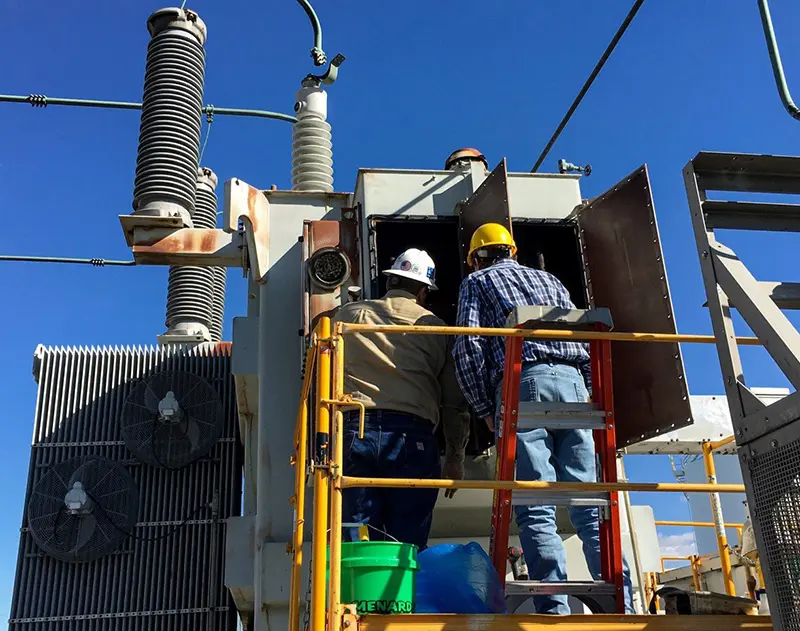
Cover photograph: Technicians inspecting transformer equipment. Image supplied by Massimiliano Vurro for editorial use; original photographer not specified.