
Should transformer criticality be ranked by the MVA rating of the unit?
No. Criticality depends on the network configuration and consequences under review: an 80 MVA unit with a usable alternative supply can have a lower interruption consequence than a 12 MVA unit feeding a process with no substitute. Record the operating state and evidence date, credit an alternative only on approved evidence of what it can supply and when, and reassess when a planned outage removes it.
A transformer criticality assessment must state the network configuration and consequences under review. An 80 MVA unit with a usable alternative can have a lower interruption consequence than a 12 MVA unit feeding a process with no substitute. During a planned network outage, that comparison may reverse without either transformer changing condition.
The assessment therefore needs an operating state and an evidence date, not only a permanent colour beside the nameplate rating.
Define what "unavailable" means
Choose a specific scenario: this transformer cannot supply its load, these other circuits remain available, and this damage boundary applies. A transformer-only outage and a fire affecting adjacent switchgear are different scenarios. Do not credit the same alternative supply in both without checking the physical arrangement.
Separate three times: electrical transfer, equipment restoration and process restart. Restored voltage does not necessarily mean restored production.
CIGRE TB 761:2019, Sections 6.1-6.2, printed pages 53-54, discusses consequences and network redundancy separately from transformer condition. Its discussion supports checking the system context; it does not supply universal criticality weights. The health-index introduction covers the separate condition question.
Prove the alternative supply
A cable shown on a single-line diagram is not proof of usable recovery capacity. Record what the alternative can supply in the configuration under review.
| Claim | Evidence needed before giving credit | Keep open if unresolved |
|---|---|---|
| "The second circuit can take the load" | Demand, power factor and approved study covering equipment and voltage constraints | Amount of demand actually supportable |
| "Transfer takes two hours" | Approved sequence, access and staffing assumptions, supporting exercise or operating record | Time until useful supply, not only breaker operation |
| "Backup covers the process" | Loads restored and dependencies on auxiliaries, controls or fuel | Production that remains interrupted |
| "The path is independent" | Check of shared switchgear, protection, fire exposure and physical access | Common dependencies |
| "Coverage returns after the project" | Confirmed restoration and relevant checks | Temporary consequence remains under review |
This is an original evidence checklist, not a switching procedure. The responsible engineers must approve transfer arrangements and any associated loading.
Compare two dated operating states
Consider an entirely hypothetical assessment dated 25 September 2026.
Transformer A is rated 80 MVA and currently serves 30 MVA. For the stated normal configuration, an approved study establishes that the alternative path can support 35 MVA under its specified conditions. An authorised transfer sequence is expected to restore the affected supply within two hours. The 5 MVA arithmetic difference is not, by itself, proof of adequacy; the study and its constraints provide that basis.
Transformer B is rated 12 MVA and serves an 8 MVA treatment process. No alternative has been demonstrated. The process owner confirms that an interruption also requires a controlled restart after supply returns. B can therefore receive the higher service-criticality category despite its smaller rating.
Now assess the planned configuration for 1-10 October 2026. A's alternative path is scheduled out of service. Its earlier transfer assumption no longer applies. Record a second assessment for that period and assign the project owner to confirm when the normal configuration has actually returned.
The dates and quantities are illustrative, not reported site events. There is no implication that either unit has a higher failure probability.
Keep the changed assumption visible
A temporary assessment should not expire silently on the planned project end date. If the project overruns, the missing alternative remains relevant until restoration is confirmed.
Keep safety and environmental consequences visible alongside service interruption. Do not average them away because the financial effect is easier to calculate.
Use the condition-monitoring record to retain condition evidence separately from these configuration changes. Before the next outage, challenge one claimed alternative: what demand can it serve, by when, and on whose verified evidence?
Talk to an engineer about the condition evidence and recovery assumptions in your assessment.
Sources and scope: CIGRE TB 761:2019, Condition assessment of power transformers, Sections 6.1-6.2, printed pages 53-54, reread in the licensed local copy on 29 September 2026; official catalogue also checked. Targeted passage review, not a full-brochure reading. The checklist and dated comparison are original planning examples.
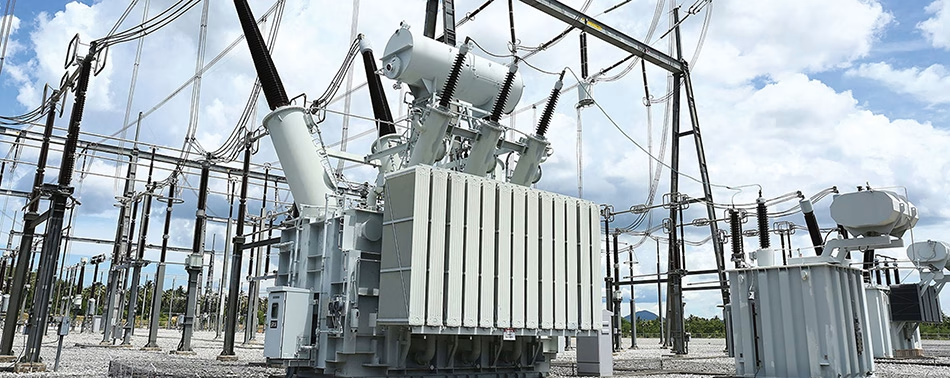
Cover photograph: Large power transformers at an outdoor utility substation. Image supplied by Massimiliano Vurro for editorial use; original photographer not specified.