


Which transformer data errors matter most when ranking assets for engineering review?
The errors that can change which transformer reaches the top of the review list, such as a result assigned to the wrong asset or compartment, a report date used as sample date, or a missing result stored as zero. Store the reported value, unit, qualifier, method, sampling date and asset together, separately from calculated indicators. Keep data-quality measures in their own queue rather than in the condition score, because they do not measure transformer health.
Transformer data quality becomes an asset-management issue when an error changes which transformer reaches the top of the review list. A missing manufacturer name may be inconvenient. A result assigned to the wrong main tank can redirect an investigation entirely.
Treat data cleanup as a decision problem. Ask what an error could change, how confidently it can be corrected, and who should approve that correction. Counting empty cells alone misses the defects that matter most.
Keep unreliable evidence visible without labelling it as either adverse condition or reassurance. The triage rules below are proposed working practices, not standard severity categories.
1. Separate the Observation From Its Meaning
Store the reported value, unit, qualifier, method, sampling date and asset association together. Keep calculated indicators in a separate layer. That makes it possible to correct an import without pretending the laboratory changed its measurement.
Three states deserve different treatment: a measured zero, a missing result, and a result reported below a detection limit. A blank cell says nothing about the concentration. A below-limit result constrains it without supplying an exact value. Replacing both with zero creates unsupported precision.
Check the laboratory's definition of the bound. A less-than qualifier may refer to a quantification or reporting limit rather than a detection limit; preserve the stated convention instead of assigning one during import.
IEC 60599:2022 addresses gas interpretation for mineral-oil equipment with specified solid insulation and requires engineering judgement in applying its guidance. Its published scope is not permission to apply mineral-oil assumptions to every fluid. Keep liquid identity visible before using the DGA interpretation workflow.
Data provenance helps distinguish an original observation from a later transformation. The non-normative W3C PROV overview supplies a general vocabulary for that distinction; the defect categories below are original transformer-specific working proposals.
2. Rank Defects by Their Effect on the Decision
Use a separate data-quality queue linked to the condition-review queue. The same asset can belong in both. The table suggests routing rules, not severity categories prescribed by a standard.
| Defect | How it can distort priority | Suggested handling |
|---|---|---|
| Wrong asset or compartment | Transfers concern to another component | Hold the affected interpretation and verify identity |
| Wrong unit or decimal placement | Changes apparent magnitude | Check the source report before recalculating |
| Report date used as sample date | Distorts elapsed time and apparent rate | Rebuild the timeline from sampling records |
| Missing result replaced with zero | Makes incomplete evidence look reassuring | Restore the missing state and reassess applicability |
| Oil treatment omitted | Makes unlike observations look continuous | Annotate the intervention and review comparability |
| Duplicate sample counted twice | Creates false evidence of persistence | Retain provenance and remove duplicate influence |
| Old result presented as current | Hides the age of supporting evidence | Display the evidence date and request review |
A useful quality metric is the proportion of issued assessments whose agreed critical fields have been checked. Define the field set and reporting period before calculating it. Another is time to resolve identity exceptions. Neither is a measure of transformer health.
Do not collapse those measures into the condition score. A transformer health index summarizes selected evidence under a chosen method. It is not automatically a calibrated failure probability, and its numerical precision cannot compensate for uncertain identity or missing measurements.
3. Correct the Time Basis Before Comparing Assets
Imagine two hypothetical mineral-oil transformers awaiting review. Asset A shows hydrogen increasing from 40 to 70 microlitres per litre, numerically ppm on this confirmed volume basis. The first sample was taken on 1 January 2026. The second was taken on 1 April, but its report arrived on 1 May. Asset B has a separate, unresolved condition concern.
In this deliberately simplified example, using the report date spreads Asset A's 30 ppm change over 120 days rather than 90 days. The arithmetic changes from approximately 0.33 to 0.25 ppm per day. Those are illustrative average changes, not diagnostic thresholds or prescribed rate methods.
The correction does not establish which asset is more urgent. It establishes that the comparison previously used inconsistent time bases. The engineer must reconsider Asset A alongside absolute values, measurement uncertainty, interventions and other evidence before deciding whether the worklist changes.
Now suppose Asset B's missing acetylene was imported as zero. Restoring the missing state may reduce confidence in its assessment. That should generate a request for missing evidence, not automatically move Asset B to the bottom of the list.
A hold on an affected calculation is not an instruction to defer a safety response. Existing alarms, protection events or other credible evidence still follow the owner's operating and escalation procedures while the data issue is resolved.
Record both corrections, identify reports affected by them, and explain any resulting priority change. A corrected database without a corrected communication trail can leave the maintenance team working from an obsolete conclusion.
4. Build a Repair-and-Review Routine
For each significant defect, assign a named owner, affected assessments, source evidence, correction, approver and closure date. Resolve patterns at their origin: a recurring unit error needs a mapping change, while recurring identity confusion needs a better asset register.
Before closing an exception, verify that the corrected evidence reached the report and worklist. Check the same failure pattern in other records from that source. Avoid rewriting historical assessments silently; distinguish the version originally issued from the revised one.
These checks cannot recover an unrecorded sampling event or prove that an old observation still represents present condition. Where evidence remains uncertain, document the next information needed and route the asset for qualified review under the owner's procedures.
Start with the records whose correction could most change the current review list. To discuss turning checked laboratory evidence into condition assessments, talk to an engineer.
Sources and Scope
- IEC 60599:2022, edition 4: public catalogue interpretation scope checked; full-text diagnostic methods not reviewed for this article, no thresholds reproduced.
- W3C PROV overview, 30 April 2013, Working Group Note, abstract and introduction: provenance concepts only.
Evidence checked on 30 September 2026. Priority-routing rules and all numerical examples are illustrative editorial proposals, not actual asset findings or a prescribed diagnostic rate method.
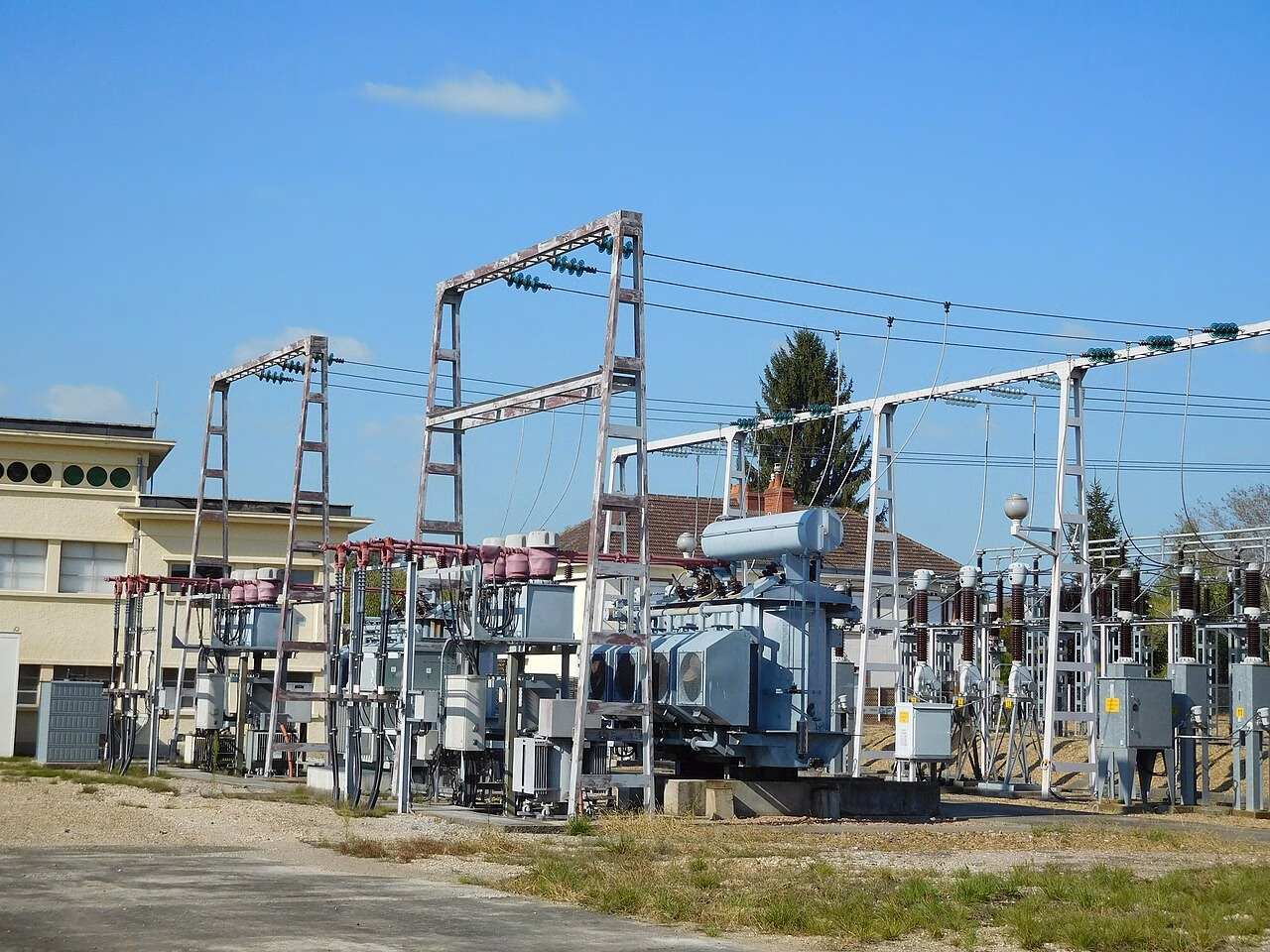
Cover photograph: A power transformer at the Cosne-Cours-sur-Loire substation in France. Photo: Cjp24 / Wikimedia Commons, CC BY-SA 4.0. Commons download, resized where applicable; no editorial retouching. Illustrative photograph, not a Seetalabs customer case or evidence of the results discussed.

.jpg)