How do you validate an AI model for transformer health assessment?
Start from what the model claims to do: reproducing an engineer’s score, classifying a gas pattern and estimating a future failure event are different tasks, and a good result on one does not validate the others. Ask for the outcome definition, the label source and a test split that matches how the model will be used, then judge it on a worked challenge rather than one accuracy figure, with uncertainty and missing data under review.
To validate AI for transformer health assessment, begin with what the model claims to predict. Reproducing an engineer's score, classifying a gas pattern and estimating a future failure event are different tasks. An impressive result on one does not validate the others.
The buyer's most useful question is: would this evaluation still work on the transformers, dates and missing-data patterns we will encounter? Answering it requires a test design, rather than one headline accuracy figure.
The tests below are proposed buyer checks, not evidence of any supplier's performance.
On this page (5 sections)
1. Define the Target and the Reference Evidence
Ask for the outcome definition, prediction horizon where relevant, label source and exclusions. An expert assessment can be a useful reference, provided the expertise, information available and disagreements are documented. A model trained to reproduce a formula mainly demonstrates agreement with that formula.
Our health index introduction explains the role of condition scoring. A health index does not become a calibrated probability because an AI model predicts it. A probability claim needs a defined event, a time horizon and appropriate outcome validation.
For a failure-within-a-year claim, ask how much follow-up each asset actually has. A transformer observed for three months without failure is not a confirmed one-year non-failure. Retain its observation duration and outcome status. Record withdrawals, repairs and lost follow-up separately; do not assume a repair is unrelated to deteriorating condition. The evaluator must justify how those cases enter the analysis. NIST's reliability handbook on censoring explains why incomplete observation is not a fully observed lifetime. It does not prescribe a transformer repair policy.
Require the evaluator to distinguish observation dates from outcome dates. Information recorded after an investigation may explain a past case very well while being unavailable at the moment a prospective decision would have been made.
For a historical deployment simulation, training labels must also have been available at the training cutoff. A pre-cutoff sample does not make a later failure outcome available early. Document the label-availability rule as well as the feature timestamps.
2. Match the Split to the Deployment
Repeated samples from one transformer are related observations. Randomly scattering them across training and test sets can answer an easier question than predicting for unfamiliar assets. The scikit-learn documentation illustrates the difference between grouped and time-ordered evaluation. Cross-validation split examples.
| Intended use | Evaluation to request | Main weakness to inspect |
|---|---|---|
| Assess previously unseen transformers | Hold out complete asset identities | Related samples on both sides of the split |
| Forecast later condition of known assets | Train before a cutoff, test afterward | Future observations entering earlier features |
| Enter a new site or laboratory | Hold out the relevant site or lab | Learning local reporting conventions |
| Handle imperfect laboratory records | Test realistic missing and censored values | Testing only unusually complete records |
| Support a rare-event claim | Report event counts and event-level results | High overall accuracy dominated by non-events |
No single split proves all five uses. For unfamiliar assets at a future deployment date, combine asset separation with time restrictions. Where observations are clustered, uncertainty estimates should reflect the clustering rather than treating every sample as independent.
Preprocessing also belongs inside the evaluation. Fit imputation, scaling and feature selection on the training portion of each fold, then apply those fitted transformations to the held-out portion. The library's data-leakage guidance explains why fitting preprocessing on the whole dataset contaminates evaluation.
3. Use a Worked Challenge, Not One Accuracy Number
Consider a hypothetical dataset with 2,400 samples from 120 transformers at four sites. A random row split produces a strong result. That result may still be useful for a narrowly defined task, but it does not establish performance on a fifth site or on new asset identities.
Request three reported evaluations: held-out assets, later observations after a fixed date, and a held-out site. Keep tuning separate from the final tests. Record how many unique assets and independently confirmed events appear in each test, not only how many spreadsheet rows. A single held-out site is still one site, not proof of generalisation to every laboratory or network.
For a classification task, inspect class-level recall, precision and the actual confusion matrix. For a score-prediction task, examine error across the score range and whether errors change review categories. Compare with an agreed simple baseline. A sophisticated model should earn its complexity on the deployment task.
Kapoor and Narayanan's research documents how leakage can make scientific machine-learning results overoptimistic. It supports scrutinizing evaluation design; it does not supply transformer-specific accuracy estimates. The authors' research on leakage.
Finally, test abstention when essential measurements are missing, a gas is below detection, or an unfamiliar liquid appears. Report coverage, meaning the proportion of eligible test cases receiving an answer, alongside error among answered cases. Selective-prediction research formalizes this distinction; it does not validate a transformer model. Geifman and El-Yaniv, 2019, section 2.
In a separate hypothetical classification test of 100 eligible cases, 60 receive answers and three of those answers are wrong: 60/100 = 60% coverage and 3/60 = 5% error among answered cases. The 40 abstentions are not correct diagnoses. Keep them in the review workload. Define eligibility and choose the abstention policy before the final test; do not exclude difficult cases after seeing their outcomes. Break down coverage and errors by class, site and liquid, with denominators visible.
4. Put Uncertainty and Change Under Review
Ask what a displayed confidence value actually means. It may represent data completeness, model agreement or an empirically evaluated interval. Those quantities are not interchangeable. If a supplier calls an output a probability, request calibration evidence for the relevant population and horizon.
Preserve the dataset version, split definitions, preprocessing and model version. Re-evaluate after changes that alter inputs or intended use. A good result on mineral-oil assets does not justify applying the same interpretation to esters.
The wider condition monitoring workflow still needs people to reconcile laboratory, operating and inspection evidence. AI evaluation does not transfer operating authority to a software score.
The next step is a written validation brief with deployment population, target, baseline, follow-up rules and acceptance evidence. To discuss the assessment workflow and its evidence requirements, talk to an engineer.
Sources and Scope
- NIST reliability handbook, section 8.1.3.1: censoring and observation time; not a transformer-specific survival model.
- SelectiveNet, 2019, section 2: coverage and risk on answered cases, not transformer performance.
- scikit-learn split examples and leakage guidance: evaluation principles.
- Kapoor and Narayanan, 2023: authors' project page and methodological research.
Evidence checked on 30 September 2026. The archived scikit-learn versions are cited for established evaluation principles, not current API behaviour. Dataset counts are hypothetical; no supplier performance, model validation or certification is asserted.
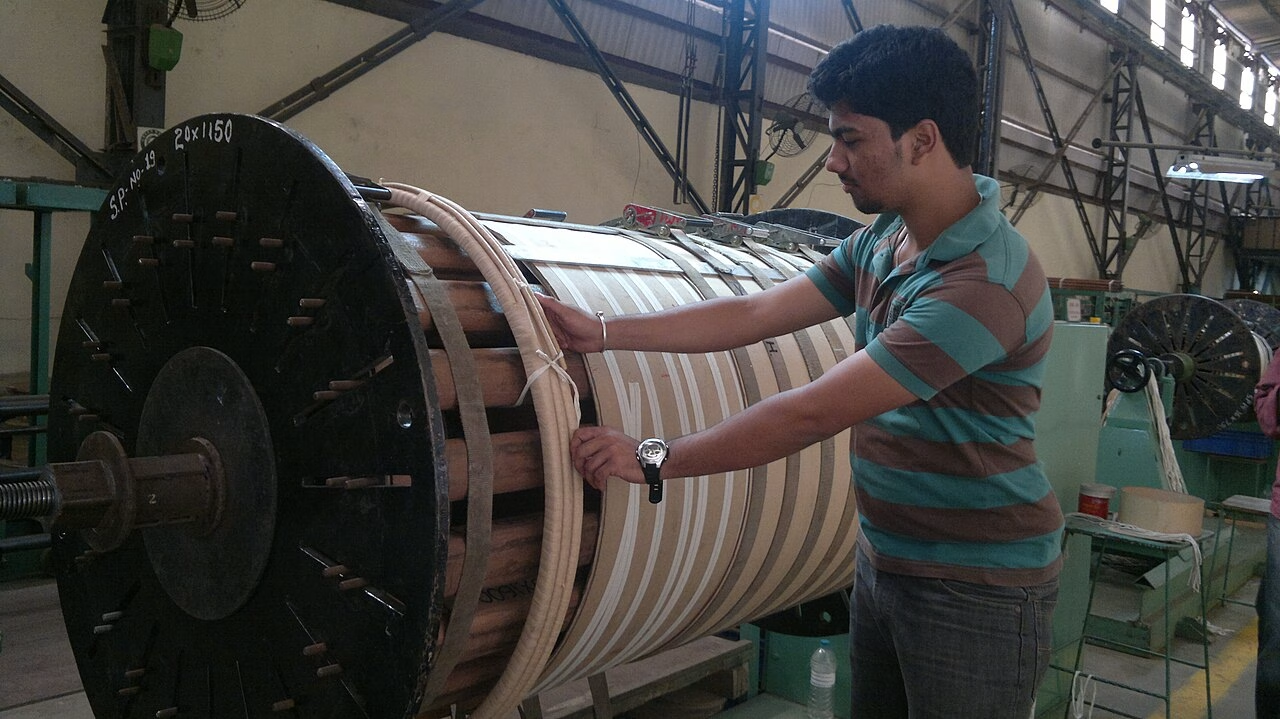
Cover photograph: Transformer manufacturing context, not a commissioning test or AI validation result. Photo: Shriram / Wikimedia Commons, CC BY-SA 3.0. Commons download, resized where applicable; no editorial retouching. Illustrative photograph, not a Seetalabs customer case or evidence of the results discussed.