
Polychlorinated biphenyls (PCBs) remain a persistent legacy in electrical equipment and other materials. The Stockholm Convention sets a 2025 goal for eliminating their use in equipment and a 2028 goal for environmentally sound waste management, with specific concentration, volume and effort provisions. National and regional obligations must be read separately: in the EU, the equipment removal deadline was 31 December 2025. This article examines those distinctions, the practical work of building a reliable transformer inventory, and a research proposal for prioritising sampling from asset records. Inventory triage can help decide where to investigate first; analytical measurements and the applicable rules determine contamination status and the required management route.
1. The chemistry and toxicology of PCBs in electrical insulating fluids
PCBs comprise 209 congeners, with one to ten chlorine atoms attached to a biphenyl structure. They were marketed in mixtures under several trade names and used in dielectric and other industrial applications. Askarel describes a class of fire-resistant insulating liquids, many of which contained PCBs; a historical fluid name is useful evidence but does not quantify the present concentration. PCB formulations were valued for dielectric and thermal properties and low flammability. Their persistence and hazardous properties now make identification, containment and controlled management essential parts of the equipment lifecycle.
The behaviour of PCBs varies by congener and environmental conditions. Persistence, movement into organic matter and bioaccumulation make releases a long-term concern, and an old commercial formulation may not exactly describe a weathered or mixed sample. IARC classified PCBs and dioxin-like PCBs as carcinogenic to humans (Group 1) in its 2013 evaluation, published in Monographs Volume 107 in 2015. That hazard classification does not estimate an individual exposure risk from an equipment label. For inventory work, preserve the analytical basis and units, prevent uncontrolled releases and use the applicable occupational and environmental procedures.
2. The scale of the problem: global inventory and the 2028 challenge
2.1 The global stockpile
Stockholm Convention reviews document a substantial global legacy of PCB-containing liquids, equipment and other materials, but estimates are sensitive to incomplete inventories and reporting. A mass of contaminated material is not the same quantity as the mass of pure PCB within it. Comparisons across reporting years should state what was counted, the concentration classes, whether equipment mass was included and how missing countries or sectors were treated. For an operator, the immediate task is a reconciled local register: equipment in use, equipment awaiting management, contaminated liquids and other materials, each linked to evidence of its present status.
Transformers are an important inventory category, together with capacitors and other electrical or industrial applications. Mineral-oil equipment can also be contaminated through oil handling and maintenance, even when it was not designed for a PCB fluid. Shared oil stocks, transfer equipment or treatment systems are therefore relevant parts of the investigation. Cross-contamination can produce different concentrations, including values above an applicable threshold; the mechanism itself supplies no upper bound. A change of oil or a newer nameplate does not establish PCB-free status without the evidence required by the applicable regime.
2.2 Differential progress across nations
Progress varies between countries and between sectors within a country. A declared phase-out in a particular programme should be distinguished from a complete national inventory and documented final management of all waste. Historical counts or a registry snapshot cannot establish current compliance on their own. The United States manages PCBs under its own TSCA framework; its definitions and authorisations must not be inferred from the Stockholm deadlines. When comparing programmes, record the reporting date, coverage, definition of equipment, concentration classes and whether disposal records have been reconciled with the inventory.
Incomplete registers, limited laboratory capacity, financing and access to authorised waste-management routes can delay identification and action. These constraints occur in different combinations across countries and asset owners. Second-hand equipment and incomplete service histories add uncertainty because a manufacturing date or country of origin may not describe later oil changes or contamination. A useful inventory programme makes those unknowns visible, assigns responsibility for resolving them and reserves resources for sampling, confirmation and the subsequent management of identified equipment.
3. International regulatory framework: the UN/UNEP Guidelines in depth
3.1 The Stockholm convention: architecture and obligations
The Stockholm Convention, adopted in 2001 and in force from 2004, lists PCBs in Annex A. Article 3 and Annex A address intentional production and use, while Article 6 covers stockpiles and waste. The equipment provisions recognise an existing installed population and set priorities for identification and removal. They should be read alongside national implementation and regional law, rather than reduced to a single worldwide ppm threshold or a uniform permission to operate until the waste-management goal.
Part II of Annex A distinguishes the goal for equipment use from environmentally sound waste management. Its wording also distinguishes determined efforts and endeavours, and makes the goals subject to review by the Conference of the Parties:
- 2025 equipment-use goal: make determined efforts to identify, label and remove equipment above 10% PCB with volumes above 5 litres, and above 0.05% with volumes above 5 litres; endeavour to identify and remove equipment above 0.005% with volumes above 0.05 litres. These are the Convention’s tiered priorities, not a statement that every jurisdiction uses identical domestic thresholds.
- 2028 waste-management goal: make determined efforts towards environmentally sound management of liquids containing PCB and contaminated equipment with PCB content above 0.005%, as soon as possible and no later than 2028, in accordance with Article 6 and subject to review by the Conference of the Parties. This is separate from removing equipment from use.
For a mass concentration, 50 mg/kg equals 50 ppm by mass and 0.005% by weight. That conversion does not create one universal legal classification: the applicable rule may also depend on volume, equipment category, intended use or waste status. Nor does a result below a particular threshold mean the material contains no PCB. Report the measured or bounded concentration, method and uncertainty, then apply the relevant legal definition.
3.2 UNEP guidance documents: a technical roadmap
The Stockholm and Basel Convention secretariats provide complementary guidance on inventories, analysis, planning and waste management. Their documents serve different purposes and should be identified by version. For transformer asset managers, the following are useful starting points:
PCB inventory guidance: the earlier UNEP/POPS/COP.10/INF/12/Rev.1 set out a common approach to inventories and PCB identification. It distinguishes information gathering from analytical confirmation and emphasises completeness, quality assurance and comparable reporting. Use the current guidance catalogue to identify subsequent revisions rather than assuming that an earlier draft remains the latest text.
Updated inventory and analytical guidance: UNEP/POPS/COP.11/INF/12 continued that work, and the Secretariat’s current guidance catalogue lists a 2024 Guidance for development of PCB inventories and analysis of PCB. Guidance updates improve the inventory process; they do not themselves amend the Convention’s legal concentration or volume provisions.
Basel technical guidelines: use the Secretariat’s adopted guidance for environmentally sound management of POP wastes and the PCB-related waste streams. Selection of a treatment route requires the waste characteristics, applicable approvals and evidence of performance, including management of emissions and residues. A generic temperature or destruction percentage is not a substitute for a permitted, demonstrated process.
Phase-out planning: the Convention’s strategy documents provide a framework for assigning responsibilities, identifying remaining equipment, financing replacement and securing treatment capacity. A national plan should connect each inventory category to an action, responsible party and evidence of completion, with dates drawn from the applicable obligations.
Spatial inventory management: a geographic register can link equipment to owners, inspections, sampling results, storage sites and treatment records. Mapping helps coordinate field work, but a point on a map is only as reliable as the underlying record. Preserve unique equipment identifiers, data provenance and controlled updates when combining registers.
3.3 European Union: regulation 2019/1021 and national implementations
The EU POPs Regulation, Regulation (EU) 2019/1021, provides the relevant regional equipment rule. Its Annex I PCB entry requires identification and removal from use of equipment containing more than 0.005% PCB and volumes greater than 0.05 dm³ (0.05 litres), as soon as possible and no later than 31 December 2025. This is a removal-from-use provision; waste management is addressed separately, including Article 7 and the applicable annexes. The volume is not 0.5 litres. A global 2028 waste-management goal is not an extension of the EU equipment-use deadline.
In Italy, the earlier PCB/PCT framework under D.Lgs. 209/1999 must be read together with the directly applicable EU POPs Regulation and current waste-management requirements. For an actual transformer, retain the concentration result, fluid volume, equipment identity, service status and management records, and resolve the applicable reporting and treatment duties with the competent authorities and authorised operators. The EU deadline cannot be replaced by an assumption that a contaminated transformer may remain in service until the end of its technical life.
3.4 United States: TSCA and EPA framework
In the United States, EPA regulates PCBs through TSCA and 40 CFR Part 761. Equipment classifications, authorised uses, registration, inspection, servicing and disposal provisions depend on the specific category and circumstances. The EPA requires registration of PCB transformers and publishes the relevant forms and guidance. The rules do not support a blanket statement that every PCB transformer in or near a commercial building has been prohibited since 1990, or that one inspection interval and one treatment method apply to all equipment. Use the current category-specific provisions and retain the required records.
4. Analytical methods and inventory challenges
4.1 Reference analytical methods
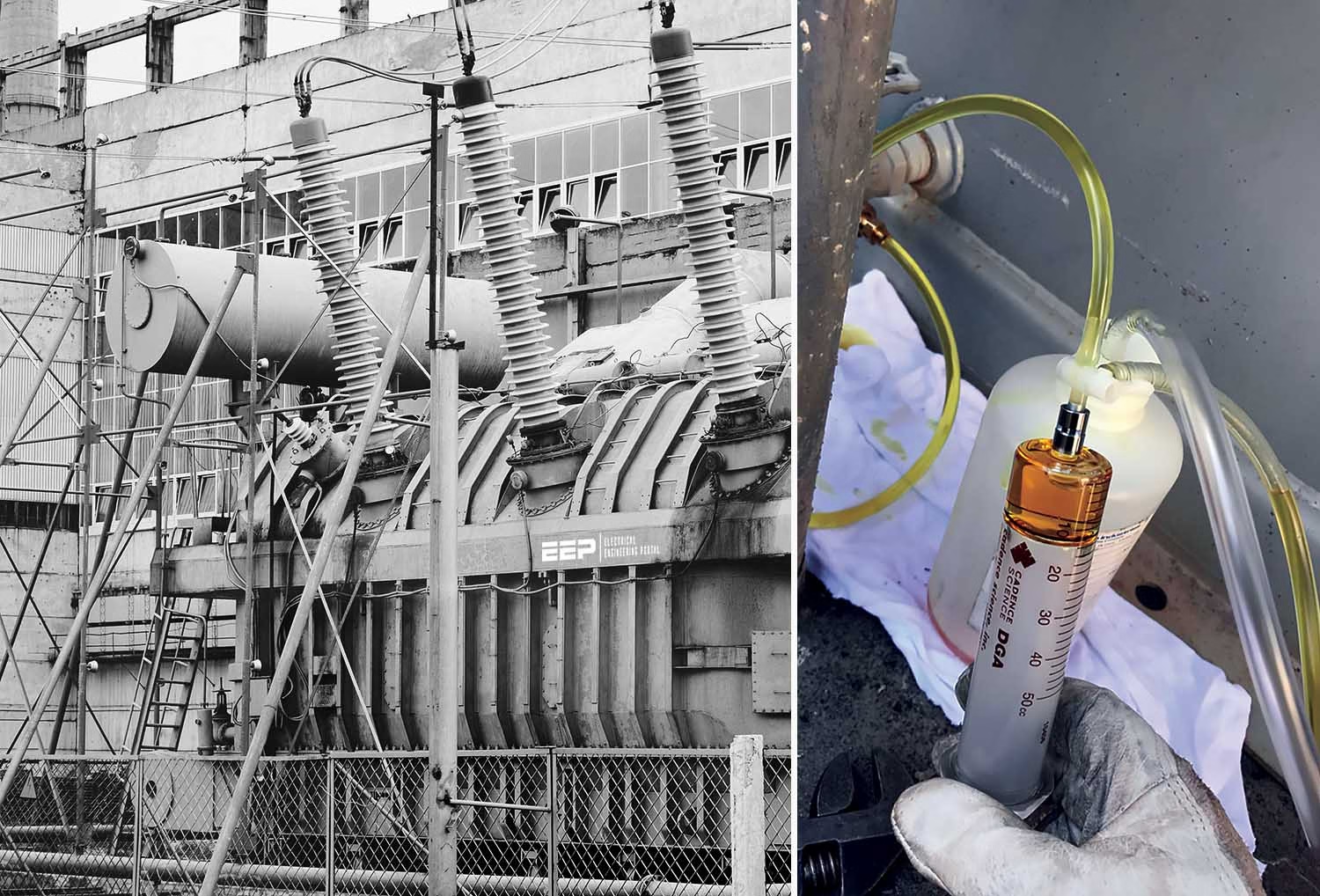
IEC 61619:1997 specifies determination of PCB concentration in non-halogenated insulating liquids using high-resolution capillary gas chromatography with electron-capture detection. The IEC catalogue identifies this edition, rather than an IEC 61619:2022 edition. The method provides total PCB content and can support detailed congener analysis; it should not be reduced to an assumed six-indicator sum. Agree the applicable method, matrix, reporting basis, detection and quantification limits, uncertainty and quality controls with the laboratory before sampling. A result is useful for a threshold decision only if the analytical capability and decision rule are appropriate to that threshold.
Field screening can help prioritise or provisionally classify samples when the selected method is suitable for the oil and decision. Different kits measure different responses, including chlorine-related signals that are not specific to PCB. Interferences and detection capability must therefore be checked for the actual product and matrix. A screen-positive result can trigger confirmatory laboratory analysis; a screen-negative result must be interpreted within the validated sensitivity and applicable regulatory acceptance. Keep screening and confirmed analytical results as distinct fields in the inventory.
4.2 The inventory problem: scope, cost and incompleteness
A national-scale transformer PCB inventory involves systematic sampling of in-service transformers, decommissioned transformers in storage, and ancillary fluid stocks. The UNEP Inventory Guidance identifies four categories of information that must be captured: equipment containing PCBs in operation, decommissioned equipment stored for disposal, contaminated liquids, and other contaminated materials. The completeness of these inventories is the Achilles’ heel of global PCB management.
National reporting to the Stockholm Convention Secretariat reveals systematic gaps. Difficulties in estimating quantitative PCB data arise from incomplete national reporting, limited coverage of voluntary survey responses, incomplete and inconsistent inventories — with countries reporting differently on equipment in operation, decommissioned equipment, and contaminated liquids — lack of analytical methods to identify PCB waste, and diverse interpretation of “PCBs in use.”
An inventory programme has several cost components: record reconciliation, site access, safe sampling, laboratory work, confirmatory tests, data review and eventual equipment management. Costs vary with geography, asset design, test method and programme scale, so a universal per-sample price or national budget is not assumed. Grouping visits and using a documented sampling design can improve efficiency. Access and electrical-safety procedures must suit the actual site; sampling does not inherently require entry into a confined space. Budget for the full chain from an uncertain register entry to a documented final outcome.
5. Beyond mass sampling: an AI-assisted approach to PCB risk stratification
5.1 The scientific basis: PCBs as a temporally-encoded signal
A useful research hypothesis is that manufacturing and oil-service histories can help prioritise which uncertain assets to investigate first. Documentary evidence already matters in conventional PCB inventory work. A statistical model could organise such evidence consistently, but it would have to be tested against independent analytical measurements. The objective is a better investigation sequence, with residual uncertainty tracked, rather than inferring a legally valid concentration from age, brand or routine transformer diagnostics.
Manufacturing period: dates and documented fluid specifications help identify equipment associated with historical PCB use. Ban dates and practices differ by country. Later manufacture may reduce some historical-use concerns but cannot exclude contamination from servicing or transferred oil. Treat date as evidence for investigation priority, with its provenance and limitations recorded.
Manufacturer and origin: an equipment family, fluid trade name or documented procurement record may identify a history of PCB-containing products. Such information should be tied to the actual model and period. A statistical association observed in one fleet does not establish a transferable probability for another country or manufacturer. Confirm the evidence and assess cross-contamination separately.
Cross-contamination traceability: In grids where maintenance records are available, oil service history (oil top-up events, oil filtration, oil reclamation) can be used to trace contamination propagation through a fleet. Maintenance equipment shared between PCB and non-PCB transformers is a known amplification mechanism.
Routine oil chemistry: acidity, interfacial tension, dielectric breakdown voltage and DGA describe aspects of fluid condition and service. They do not measure PCB concentration. Their incremental value as predictors would have to be demonstrated against confirmed PCB analyses, after accounting for age, maintenance and selection effects. They should not be used as a negative screen or as evidence that an oil is PCB-free.
5.2 Towards a predictive PCB sampling-priority model
A possible Seetalabs research direction is to combine nameplate, procurement and maintenance records into a model that ranks uncertain assets for investigation. The output would be a sampling priority or a calibrated probability with uncertainty, supported by analytical labels. No fraction of the fleet or percentage of contaminated units recovered can be specified before a representative evaluation. Statutory sampling or classification requirements continue to govern the programme.
The asset-data infrastructure used in transformer condition assessment could also support this work: unique equipment IDs, dated measurements, traceable maintenance events and controlled data quality. PCB prediction is a separate task with separate labels and validation. Candidate inputs to evaluate include:
- Nameplate features: manufacturing year, rated voltage, rated power, manufacturer, cooling class, country of manufacture
- Installation context: geographic region, customer sector (industrial, utility, commercial), installation date, operational history
- Oil service history: number of oil top-up events, oil filtration records, oil reclamation records, oil origin and supplier
- Historical oil chemistry: a candidate research input only. Evaluate whether these measurements add reliable information beyond provenance and service history; retain the laboratory PCB result as the contamination reference.
- Maintenance event history: inspection records, previous non-routine interventions
A valid study needs confirmed PCB measurements from a sufficiently representative sample, including equipment that the model ranks as low risk. Otherwise, testing only suspicious assets can create selection bias and leave the missed-contamination rate unknown. Split development and evaluation by meaningful asset, owner, time or service-network groups to limit leakage. Compare the model with simple documentary prioritisation, report sensitivity, precision and calibration with uncertainty, and validate across different fleets before extending its scope. A health-index formula cannot supply PCB labels, and reproducing any formula’s outputs would not independently validate this different task.
5.3 Feature importance hypotheses
The following candidate variables illustrate what could be tested. Their importance and direction must be estimated from evidence; they are not established diagnostic rules or a validated ranking:
Manufacturing year: potentially informative when linked to documented product and country histories. The most important predictor cannot be chosen in advance, and missing or uncertain dates need explicit handling.
Manufacturer identity: Documented through institutional memory, industry databases, and regulatory submissions for major utilities. Manufacturers known to have used Askarel formulations in specific product lines would contribute a positive risk signal.
Voltage class and application: possible descriptors of equipment populations, not proof of original PCB filling. Indoor fire-protection requirements, product design and fluid records are more specific evidence than a blanket assumption about transmission or distribution voltage.
Oil acidity: a measure relevant to oil condition, with many possible influences. Any relationship with PCB presence would be exploratory and must be checked against laboratory PCB results and confounding factors.
Interfacial tension: another oil-condition measurement to evaluate, if available. Changes alone cannot establish PCB content or replace the relevant analytical test.
DGA patterns: useful for their own diagnostic purpose, but not an analytical test for PCB. An unusual gas pattern may justify investigation of fluid history without identifying which contaminant, if any, is present.
5.4 The cross-contamination pattern problem
One of the most technically interesting aspects of PCB contamination in working transformer fleets is the phenomenon of cross-contamination propagation. In power grids where centralized oil maintenance practices were historically applied — using shared filtration trucks, common oil storage, or standardized top-up procedures across a mixed fleet — PCB contamination can propagate through an initially clean fleet over time. This propagation follows network topology: substations sharing maintenance crews or oil supplies form contamination clusters. Network graph analysis of maintenance event records could theoretically identify these clusters and predict propagation risk even in the absence of direct PCB measurements on all nodes.
A graph of shared oil supplies and maintenance equipment could help investigate possible contamination pathways. Its links would need dated documentary evidence and analytical checks. Geographic proximity alone is not proof of common service history, and a plausible connection is not a confirmed contamination event. This remains a study design to evaluate, rather than an established operational detector.
6. Disposal technologies and the end-of-life challenge
6.1 Selecting an authorised treatment route
The Stockholm Convention’s waste provisions and Basel technical guidance emphasise environmentally sound management, including destruction or irreversible transformation of POP content where required. A practical treatment decision must satisfy the applicable law and facility permit for the actual waste stream. Technology names alone do not demonstrate approval. The following categories illustrate the options that a qualified waste-management assessment may consider:
Thermal treatment: suitable permitted facilities can destroy PCBs under controlled operating conditions. Acceptance criteria, destruction performance, air emissions, residues and monitoring need to be assessed together. One temperature-and-time recipe is not a universal authorisation or proof that unwanted by-products are controlled.
Chemical treatment: specialised processes can remove chlorine from PCB molecules under controlled conditions. Applicability depends on the liquid and concentration, the permitted process, analytical verification and management of all outputs. Decontaminating a liquid also requires attention to the equipment and materials that may retain contamination.
Plasma-based treatment: this is another specialised technology category. Its suitability must be demonstrated for the waste stream, facility and regulatory approval; a high process temperature alone is not sufficient evidence of environmentally sound disposal.
Mechanochemical treatment: research and specialised applications explore destruction or transformation using mechanical energy and reagents. Consider scale, validated performance, containment and residues before comparing it with an established permitted route. A promising study does not establish availability or approval for a national transformer programme.
6.2 The economic case for elimination
The economic assessment should include investigation, replacement or decontamination, transport, authorised treatment and documentation, together with operational constraints. Benefits can include reduced spill exposure, removal of a legacy management burden and, where a replacement is justified, improved efficiency or reliability. Calculate those benefits from the actual equipment and alternatives rather than assuming that they exceed costs. Compliance duties, the condition of the asset and the financial comparison are related but distinct reasons for action.
7. The 2025 Deadline: state of compliance and outlook
7.1 EU: action and evidence after the removal deadline
The EU removal deadline has passed. An operator should now reconcile the equipment register with evidence of removal, decontamination or other lawful management, and identify unresolved entries for action. A claim of near-complete elimination needs current, clearly scoped reporting; this article does not infer national completion from selected utility projects or an unsupported percentage. Industrial sites, stored equipment and unrecorded service histories deserve attention alongside the main utility fleet.
Where equipment covered by the EU provision remains in use or its status is uncertain, address the case promptly under the applicable rules and competent-authority procedures. The 2028 Stockholm waste-management goal is not a grace period for EU operation after 31 December 2025. Retain the evidence connecting equipment identity, analytical results, removal from use, transfer and final management so that an entry is closed on documentation rather than on an assumption.
7.2 Global picture: a structural shortfall
Convention reporting continues to identify incomplete inventories and obstacles to environmentally sound management. Historical reporting counts describe the submissions available at a particular date; they should not be reused as a current compliance rate. Assess progress from the latest national reports and their coverage, including equipment in use, liquids and equipment in storage, and documented treatment. Gaps in analytical capacity, financing or authorised disposal can require coordinated programmes, but the scale and priorities need country-specific evidence.
International technical-assistance and financing programmes can help countries develop inventories, analytical capacity and waste-management plans. For any programme cited, distinguish its planned outputs from verified quantities actually managed. A completed training event or procurement process is not evidence that every item in a national inventory has been eliminated.
8. Intersections with transformer health indexing
PCB status and transformer condition belong in the same asset record because both can affect operating, maintenance and replacement decisions. They remain different assessments: a transformer can have satisfactory operational diagnostics while carrying a contaminant-management obligation. A dashboard should preserve that distinction and expose the evidence behind each status.
DGA and fluid identity: DGA measures dissolved gases for condition assessment; it does not determine PCB concentration. Record the liquid family, known mixtures and treatment history so the engineer can select an applicable interpretation method. Do not assume that trace PCB contamination creates a unique, reliably detectable conventional DGA signature.
Oil-quality evidence: acidity, IFT, breakdown voltage, moisture and dissipation factor address fluid condition. Keep the PCB analytical result separate. If a future research model uses routine oil tests, demonstrate their added predictive value and uncertainty before allowing them to influence sampling priority; they cannot by themselves certify contamination status.
Fleet records: asset identity, procurement and service history can support both condition management and a PCB inventory. An integrated workflow could show confirmed contamination, documentary suspicion, sampling status and unresolved uncertainty next to condition assessments. This makes actions easier to coordinate while preserving the different evidence required for an engineering diagnosis and an environmental classification.
9. Conclusions and research directions
The 2025 equipment-use goal and the 2028 environmentally sound management goal address different stages of the PCB legacy. Regional rules may create more specific duties, as the EU equipment provision illustrates. Progress should be measured through current inventories and documented outcomes, with reporting gaps exposed. A date on a calendar does not itself prove that equipment has been identified, removed or properly managed.
The next operational challenge is to turn uncertain records into defensible decisions. That requires identifying equipment, tracing oil history, selecting suitable samples and analytical methods, and ensuring a lawful route for the material that is found. Laboratory and disposal capacity, logistics, costs and data quality all matter. A programme that optimises sampling but cannot act on positive results has addressed only part of the problem.
A practical programme combines three elements. First, reconcile and standardise asset and service records while preserving provenance. Second, use a documented sampling design that addresses both high-priority cases and uncertainty in the remaining population. Third, connect confirmed findings to authorised equipment and waste management, with records that demonstrate completion. A statistical prioritisation model could be evaluated within that workflow, alongside simpler documentary rules, rather than replacing the analytical and regulatory steps.
For the proposed research, the next deliverable would be a representative labelled dataset and an evaluation protocol, not a promised percentage reduction in sampling. Measure how many confirmed contaminated assets are found, how many are missed, what uncertainty remains in low-priority groups and whether the method transfers to another fleet. Include sampling and follow-up costs in the comparison. This is how a potential efficiency gain can become evidence for a decision, without claiming that routine oil chemistry or AI has measured PCB concentration.
The useful contribution of better data is traceability: knowing which equipment has been assessed, what the evidence establishes and what action remains. Analytical confirmation, documented management and careful prioritisation can then work together to reduce the unresolved legacy in electrical infrastructure.
References and further reading
International Framework:
- Stockholm Convention on Persistent Organic Pollutants (2001, entered into force 2004). Annex A, Part II — Polychlorinated biphenyls.
- Stockholm Convention Secretariat. Strategy documents for Parties to meet the 2025 and 2028 PCB goals, including UNEP/POPS/COP.11/INF/13. Read as planning guidance alongside the Convention text.
- Stockholm Convention Secretariat. Guidance for development of PCB inventories and analysis of PCB: earlier UNEP/POPS/COP.10/INF/12/Rev.1, followed by updated guidance listed in the Secretariat’s current catalogue.
- Stockholm Convention Secretariat. PCB progress reports, including UNEP/POPS/COP.11/INF/11. Use the reporting period and coverage stated in each report.
- Basel Convention Secretariat. Adopted technical guidelines on environmentally sound management of POP wastes and PCB-related wastes, available in the official guidance catalogue.
EU and National Regulation:
- European Commission. Regulation (EU) 2019/1021 on persistent organic pollutants (recast). Official Journal of the European Union.
- Italy. D.Lgs. 209/1999 on PCB/PCT disposal, to be read with Regulation (EU) 2019/1021 and the applicable current waste-management provisions.
- US EPA. PCB regulations and PCB transformer registration guidance under TSCA and 40 CFR Part 761.
Health evidence and inventory methods:
- IARC. Monographs Volume 107, Polychlorinated Biphenyls and Polybrominated Biphenyls (2015), following the 2013 evaluation.
- Stockholm Convention Secretariat. PCB inventory guidance: scope, equipment identification, sampling, analytical quality and inventory maintenance.
- Research evaluation: independent analytical PCB results are required to test any proposed asset-record prioritisation model; no numerical detection or cost-saving performance is asserted here.
Standards and Technical Guidelines:
- IEC 61619:1997. Insulating liquids — Contamination by polychlorinated biphenyls (PCBs) — Method of determination by capillary column gas chromatography.
- IEC 60475:2022. Method of sampling insulating liquids. Apply with the selected PCB analytical method and relevant site and sample-management requirements.
- CIGRE TB 761 (2019). Condition assessment of power transformers. WG A2.49. Context for asset assessment; not an analytical PCB identification method.
AI and Transformer Health:
- Seetalabs. Transformer assessment project information is available at www.seetalabs.com. The PCB sampling-priority model discussed here is a research proposal with a separate analytical validation task.
- Chen, T., & Guestrin, C. (2016). XGBoost: A Scalable Tree Boosting System. Proceedings of the 22nd ACM SIGKDD International Conference on Knowledge Discovery and Data Mining, 785–794.
Technical references: Stockholm Convention PCB overview and inventory guidance catalogue; Regulation (EU) 2019/1021, Annex I PCB entry and Article 7; Basel adopted technical guidelines; IEC 61619:1997; IEC 60475:2022; EPA transformer registration; IARC Volume 107. Checked 1 October 2026.