Use transformer condition data to support your reliability centered maintenance plans.
A fleet calculation may take seconds once usable data is available. Collecting that data, validating it and deciding what to do are separate jobs. This article looks at where RONIN AI can support the assessment workflow and where the engineering work remains.
Reliability centered maintenance: balancing cost, time & quality
Reliability centered maintenance (RCM) starts with the functions an asset must perform, the ways those functions can fail and the consequences of failure. Maintenance tasks are then selected for those failure modes. Condition monitoring is one input to that process. For transformers, sampling, testing and diagnostic review provide evidence that helps the asset manager:
- Establish a documented process that turns observations into actions
- Use an appropriately designed health index to screen the fleet and prioritize further investigation
A health index can support an initial fleet ranking. A manual workflow may include sample collection, laboratory testing, data validation, diagnosis and preparation of recommendations. An automated calculation accelerates only part of that chain. Both approaches still need suitable measurements and a responsible engineer to interpret the results.
A semi-automated workflow uses a tool such as RONIN to assist with data organization and index calculation. Its output must be reviewed in the context of the transformer, its operating history and the quality of the available data.
The historical illustrations below compare activities in manual and software-assisted assessment of a single transformer. Read them as workflow illustrations, rather than measured performance benchmarks.
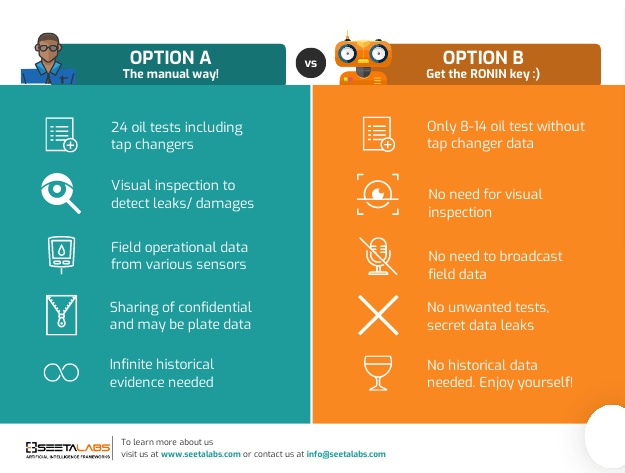
Costs and lead times depend on sampling logistics, laboratory turnaround, data preparation and the depth of engineering investigation. A fair comparison must use the same starting point and include the same activities on both sides.
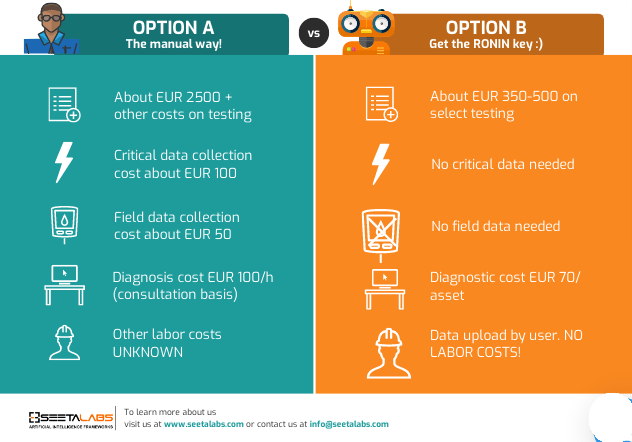
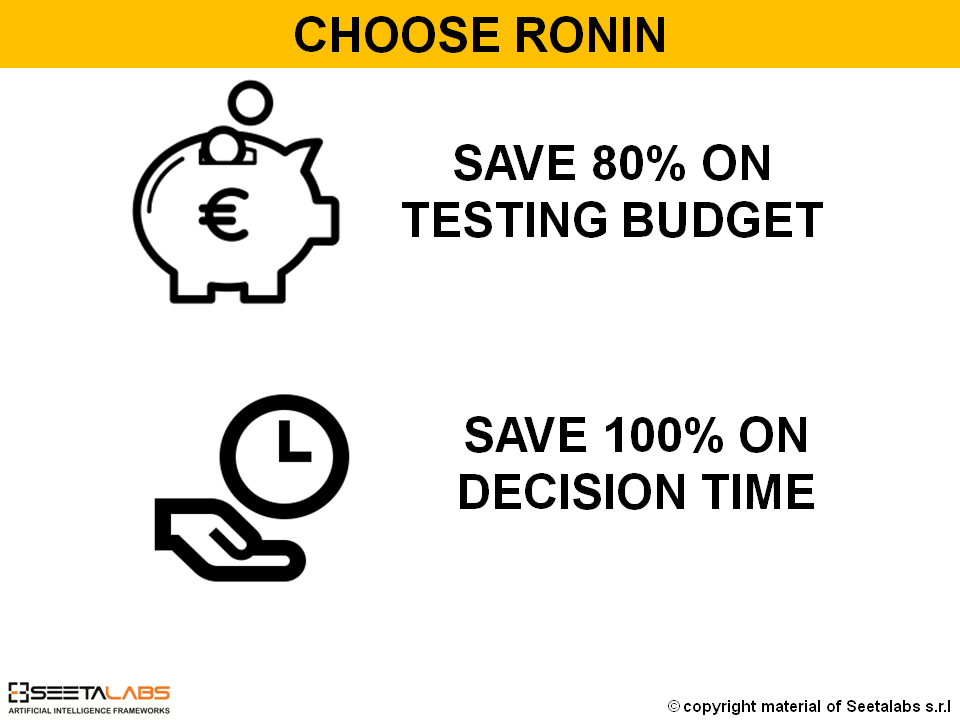
The original graphics contrast an assumed 50-day manual process with a six-second software calculation. Those durations cover different tasks and do not establish an equivalent reduction in maintenance or decision time. Sampling, testing, validation and engineering review remain necessary. The practical benefit to evaluate is the time saved in handling and screening already available data.
The broader RCM process includes failure modes, consequences and task selection; the NASA maintenance guidance describes that scope. A health index can support the process without replacing it.
Do you want to know more? Drop a comment below or request for an offer