
A maintenance trigger needs an identifiable observation and a decision to resolve. "Gas rising" is incomplete when the earlier result was never a numerical measurement. Correcting that data problem is necessary, but it does not automatically close the technical concern.
The following hypothetical case follows one main-tank DGA finding from receipt to review. It defines neither an alarm threshold nor an operating instruction.
Start with the two laboratory reports
T-17 is a fictional mineral-oil transformer. Its earlier main-tank hydrogen result is reported as <2 ppm (LOD), but the database stores zero. Here LOD means the laboratory's stated limit of detection, and ppm is gas volume per liquid volume. A sample collected 30 days later reports 6 ppm.
The displayed increase of 6 ppm and slope of 0.20 ppm/day were calculated from that stored zero. They are not differences between two measured concentrations. Replacing the earlier result with 2 ppm would not fix the problem: the laboratory did not report a measured value of 2 ppm either.
Retrieve both reports and preserve the earlier qualifier, stated limit, units and sample date. A non-detect is not a measured zero or a certainty about the true concentration. IEEE C57.104-2019, Section 5.2.1, also warns that relative uncertainty can be substantial near analytical detection limits.
The new 6 ppm result remains part of the record. Its significance requires review of analytical quality, the wider gas pattern and the transformer's history; this example does not classify it as normal or abnormal. Our DGA guide supplies the broader interpretation context.
Write one trigger that can be closed properly
A useful entry names the component and the unresolved question. For T-17, the trigger is: an apparent hydrogen change depends on a wrongly stored prior non-detect; establish whether the available results support a technical concern after correcting the record.
| Field | T-17 entry in this hypothetical case |
|---|---|
| Evidence | Two original main-tank certificates; earlier qualifier lost during entry |
| Question | Is there a meaningful change after considering comparability and analytical uncertainty? |
| Owner | Named diagnostic engineer; data custodian responsible for correcting the stored result |
| Closure evidence | Corrected source-linked record and a signed conclusion resolving the question; a pending follow-up keeps the technical finding open |
CIGRE TB 962:2025, Sections 3.5-3.6, printed pages 39-41, discusses technical records, test repeatability and their use in maintenance decisions. The four-field format above is an original implementation suggestion.
Correct the data, then decide what evidence is needed
The engineer checks asset identity, sample compartment, fluid, sampling dates, laboratory methods and recent oil treatment. A certificate assigned to the wrong tank needs a different response from a comparable measurement that supports a developing trend.
Suppose the records confirm the correct main tank and reveal no intervening oil work, but leave analytical comparability unresolved. The next request might be clarification from the laboratory before another visit is purchased. If a repeat sample is needed, specify the question it must answer and who will interpret the result.
Keep the original certificate and the correction history linked to the amended entry. Do not overwrite the source report to make it agree with the database. An unresolved follow-up needs a named reviewer and due date under the owner's process.
Do not close the technical finding when the bottle is dispatched. Sampling completes a task; review completes the associated decision. Equally, an overdue review is an outstanding responsibility, not proof that the transformer has deteriorated.
Close only the issue demonstrated
A defensible interim conclusion would be: "The historical reporting error is corrected. The technical assessment remains open pending laboratory clarification."
If the subsequent review supports an intervention, create a separate scope with acceptance evidence. If it supports continued surveillance under the owner's procedure, record the reasoning and the observation that would trigger reconsideration.
Response timing belongs to the site's approved process and the significance of the concern, not a universal deadline supplied by an article. Existing required maintenance remains in force. Nothing in this example authorises continued operation or shutdown.
For the wider process, see transformer condition monitoring. Take one unresolved finding to the next meeting with its actual reports, not only its chart. Talk to an engineer about the evidence needed to resolve that finding.
Sources and access: CIGRE TB 962:2025, Sections 3.5-3.6, printed pages 39-41; IEEE C57.104-2019, Sections 5.2.1-5.2.2, printed pages 26-27. Targeted passages reread in licensed local copies, not full-document reviews. IEEE's public December 2019 erratum was also checked; it concerns Figure D.1, which this article does not use. T-17 and its results are invented; no diagnostic threshold is proposed.
Cover: AI-generated conceptual illustration, not a real laboratory, certificate or approved DGA sampling arrangement. Use the applicable sampling procedure and specified containers, not the illustration, for field work.
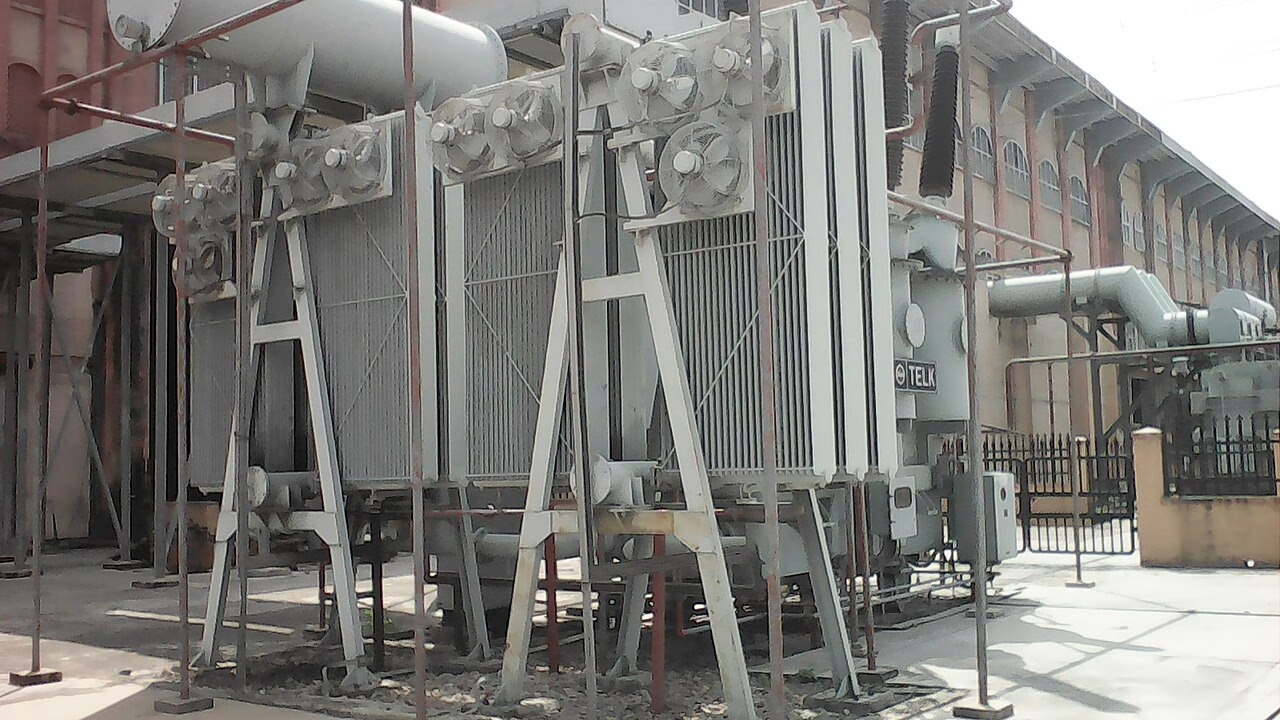
Cover photograph: Cooling fans and radiator banks on a power transformer. Photo: Shivashishpandey35 / Wikimedia Commons, CC BY-SA 4.0. Commons download, resized where applicable; no editorial retouching. Illustrative photograph, not a Seetalabs customer case or evidence of the results discussed.