
In modern electrical Asset Management, decisions regarding the maintenance, refurbishment, and replacement of power transformers can no longer rely on arbitrary age-based estimates. The CIGRE Technical Brochure 761 (TB 761), published in 2019 under the title “Condition Assessment of Power Transformers”, has rapidly become the global benchmark for evaluating the health of these critical assets from a rigorous engineering perspective.
But what exactly does it mean to meet CIGRE TB 761 compliance requirements?
While CIGRE does not issue legally binding “laws,” compliance with its frameworks is now a de facto prerequisite demanded by utilities, industrial insurers, and grid regulators (e.g., using Weibull reliability curves to justify CAPEX). This article provides an in-depth analysis of the technical requirements to correctly implement this framework, integrating the latest research and condition monitoring technologies.
1. The Architecture of Requirements: The Tiered Approach
The CIGRE TB 761 compliance requirements reject the concept of a “one-size-fits-all” equation for calculating the Transformer Health Index (HI). Instead, the framework mandates a strict, hierarchical approach based on data availability and asset criticality:
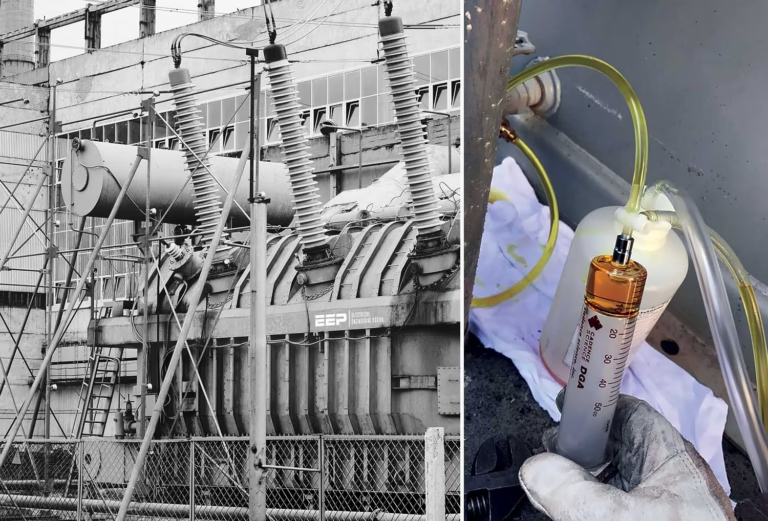
- Tier 1 (Fleet Screening): The baseline assessment for entire transformer fleets. Minimum requirements include routine oil test results (dielectric breakdown voltage, water content, acidity), Dissolved Gas Analysis (DGA), and basic visual inspections.
- Tier 2 (Detailed Condition Assessment): Triggered when Tier 1 highlights anomalies. This tier requires advanced electrical and chemical diagnostics: furanic compound testing, Tangent Delta (Dissipation Factor) measurements, Sweep Frequency Response Analysis (SFRA), and advanced bushing diagnostics.
- Tier 3 (Expert Analysis): The highest level, usually reserved for post-failure forensic investigations or End-of-Life evaluations. It includes internal inspections, material teardown tests, and thermal hot-spot simulations.
Compliance Benchmark: To declare adherence to TB 761, diagnostic software algorithms must dynamically scale the Health Index calculation based on the available data tier (Tier 1, 2, or 3). A compliant system will never artificially inflate or skew a health score when complex variables are missing.
2. Sub-Component Monitoring Requirements
A critical failure in amateur asset management is evaluating the transformer as a single, monolithic block. CIGRE TB 761 strictly requires breaking the asset down into sub-components, each generating an independent health score that feeds into the final matrix:
A. Solid Insulation (The “True Life” of the Transformer)
The thermal degradation of Kraft paper (cellulose insulation) is irreversible. The framework mandates estimating the Degree of Polymerization (DPest).
- Compliance Parameter: Utilize the analysis of 2-Furaldehyde (2-FAL) dissolved in the insulating oil. According to risk matrices derived from TB 761 and the foundational TB 323, a DP > 700 indicates pristine condition, whereas a DP <= 200 signals the end of the insulation’s mechanical life, leaving the transformer at extreme risk of failure under short-circuit stress.
B. On-Load Tap Changers (OLTC) and Bushings
Historically, these components account for over 40% of catastrophic transformer failures.
- OLTC Parameters: Monitoring temperature differentials, compartment-specific DGA, and dynamic resistance or motor current signatures during tap changes.
- Bushing Parameters: Measuring power factor (Tan delta) and capacitance. Recent CIGRE guidelines (including the 2024 TB 939 updates on reliability) heavily emphasize the online monitoring of leakage currents to mitigate the rapid thermal runaways typical of RIP/OIP (Resin/Oil Impregnated Paper) bushings.
3. Data Ponderation and Health Index Scoring
The mathematical modeling of asset health is the core of CIGRE TB 761 application. When designing algorithms, CIGRE TB 761 compliance requirements dictate two golden rules:
- Weighting Factors: Not all parameters are created equal. Active arcing indicated by DGA or high moisture in solid insulation must carry a mathematically heavier weight than superficial anomalies, such as tank paint degradation.
- The “Worst-Case” Rule (Limiting Factor): A compliant algorithm must not allow excellent oil test results to “mask” severely degraded bushings through simple averaging. If a critical sub-component enters the “Red Zone” (e.g., exponentially rising Ethylene or Hydrogen levels), the overall Health Index must be forced to indicate a critical state, overriding the mathematical mean.
4. Emerging Technologies & Research Frontiers (2024-2026)
Transformer engineering is highly dynamic. Recent scientific research and international symposiums (such as the CIGRE Paris Sessions) have introduced vital evolutions for maintaining compliance in grids increasingly stressed by renewable energy integration:
- Edge Computing & Multi-Gas Online DGA: While the original TB 761 relied heavily on annual lab sampling, today’s compliance requirements for strategic assets demand real-time monitoring. Algorithms embedded directly into online monitors (Edge AI) interpret gas trends according to IEC 60599, dynamically cross-referencing them with CIGRE health index calculations.
- Ultra-High Frequency (UHF) Partial Discharge: Complementing TB 761 (and referenced in TB 861 for acceptance testing), online PD monitoring via UHF sensors on drain valves is becoming a premium requirement to detect localized insulation defects and surface tracking before catastrophic breakdown.
- Machine Learning for Remaining Useful Life (RUL): Modern diagnostic platforms do more than output a static Health Index. By utilizing neural networks trained on the Fault-Tree Analysis degradation models suggested by CIGRE TB 761, systems now cross-reference dynamic hot-spot temperatures with real-time grid loading, accurately predicting the theoretical end-of-life year and optimizing replacement budgets.
Conclusion
Fulfilling CIGRE TB 761 compliance requirements is the bedrock of any proactive, efficient high-voltage maintenance program. It is no longer just about “collecting data”; it is about translating complex chemistry, electrical testing, and visual inspections into a standardized, irrefutable Risk Management framework.
For O&M managers and grid engineers, the rigorous adoption of CIGRE TB 761 not only extends the operational lifespan of the asset but also provides the technical and scientific authority required to justify capital expenditures (CAPEX) or operational interventions (OPEX) to top management and regulatory bodies.