
An auditable transformer condition report preserves the evidence used for a decision, even after measurements or methods are corrected. Another engineer should be able to reconstruct the interpretation, challenge its assumptions and identify who approved the next step. A PDF linked only to a changing spreadsheet cannot reliably provide that history.
The report structure below is an original engineering template. It is intended for laboratory-based condition review, with operating and inspection evidence added where relevant. It is not an automatic instruction to operate, stop or replace equipment.
Give the Reader a Decision and Its Evidence Boundary
Start with asset identity, assessment date, evidence cutoff, purpose and reviewer. State the decision the report supports. A report for selecting the next investigation needs different detail from one prepared to compare replacement options.
List what was examined and what was unavailable. Identify liquid type, equipment role, sampling compartment and significant interventions. Use the sampling date for laboratory observations, while retaining report and analysis dates separately.
Keep a short conclusion near the front: the concern, the strength of the supporting evidence, unresolved alternatives and the proposed next evidence. A health index can help organize the assessment, but does not replace these statements or supply a calibrated probability of failure.
CIGRE Technical Brochure 761, published in 2019, concerns transformer condition assessment and fleet-ranking indices. Its scope supports discussing structured assessment; it does not make a custom report template or a supplier's numerical bands mandatory.
Preserve the Chain From Observation to Approval
The non-normative W3C PROV overview describes provenance using entities, activities and responsible actors. Apply that distinction in plain language so an engineer can inspect the chain without knowing a data modelling language. An original laboratory file is one entity; its conversion into normalized measurements is an activity; the person or software responsible belongs in the record. W3C provenance overview.
| Report element | Minimum useful content | Audit question it answers |
|---|---|---|
| Evidence register | Report ID, sample ID, source, date and asset association | Which observations were available? |
| Normalized measurements | Value, unit, qualifier and transformation | What did the assessment actually use? |
| Method record | Method name, edition or version, applicability | Why was this interpretation selected? |
| Interpretation | Finding, alternatives and limitations | What does the evidence support? |
| Proposed response | Next evidence, owner and agreed review point | What work was being proposed? |
| Decision record | Approver, decision date and rationale | Who accepted or changed the proposal? |
| Revision record | Superseded version and reason | Why does the current report differ? |
Keep original laboratory records accessible through the owner's controlled document system. A checksum can help detect later file changes, but it does not prove that the sample was correctly taken or assigned. Identity and sampling evidence still need review.
Keep the reference checksum in a controlled record too: replacing both the file and an unprotected checksum can conceal a change. Retain the exact source versions, transformation settings and method version used at issue. A link to a folder whose contents keep changing is not a frozen evidence package. Set access and retention with the document owner so the next authorized reviewer can retrieve it without exposing operational information unnecessarily.
For gas interpretation, name the actual method used and its applicability. The DGA guide gives background; the asset report must point to its own measurements. When two methods disagree, record the disagreement and the reason for the review conclusion.
Write One Finding That Can Be Challenged
Consider a hypothetical mineral-oil transformer with two main-tank laboratory samples on confirmed dates. Hydrogen is reported as 38 and 61 ppm on the same volumetric reporting basis, equivalent here to microlitres of gas per litre of oil under the laboratory's stated reference conditions. The second report gives acetylene as <0.5 ppm. Preserve the laboratory's meaning of that qualifier; do not silently label it a detection limit if the report does not say so. A work order mentions oil processing between the samples, but its completion date has not been confirmed.
A defensible finding would record the observed hydrogen difference, 61 – 38 = 23 ppm, without assuming a continuous untreated trend. This is a difference between reported values, not an established gas-generation rate or a statistically significant increase. It would retain the acetylene qualifier, identify the intervention uncertainty, and request the treatment record before attributing the change to a particular mechanism. Comparability of sampling, analytical methods and measurement uncertainty still needs review.
The report could propose that the responsible engineer reconcile the intervention history and determine whether additional sampling or other tests are needed under the owner's procedures. It should not turn the two numbers into a fault-temperature estimate or an automatic operating decision.
Now suppose the corrected work order confirms oil processing between the samples. The revised report can resolve the timing uncertainty while retaining the limitation on interpreting an uninterrupted trend; the two hydrogen results alone still do not identify a fault. Link the revision to both the original assessment and corrected work-order version. Record its new approval and distribution decision, without implying that the earlier approval covers the revised content. Do not overwrite the old conclusion and leave a misleading impression that the evidence was always complete.
Test Whether the Report Survives Handover
Before issue, give the report to a qualified colleague who did not prepare it. Ask them to locate the source of one measurement, reproduce one simple calculation, identify the missing evidence and explain who owns the next action. Record any point at which they must ask the author for undocumented information.
ISO 55001:2024 places asset-management decision-making within a management-system context. The ISO committee's public overview explains this development; it does not certify a report generated by software. ISO TC 251 overview.
Keep the report proportionate. A concise evidence register and clear limitations are more useful than pages of repeated boilerplate. Neither a digital signature nor an attractive export can repair an unsupported interpretation.
Use the handover test on one recent report before redesigning the reporting process. Talk to an engineer about the evidence trail your review needs to preserve.
Sources and Scope
- CIGRE TB 761, 2019: edition and condition-assessment scope verified; no full-text reporting requirement asserted.
- W3C PROV overview, Working Group Note of 30 April 2013: abstract, status and introduction read; a non-normative overview, not a required report format.
- ISO TC 251 overview of ISO 55001:2024: public management-system summary; full standard requirements not reviewed.
Evidence checked through 30 September 2026. The template, handover test and sample finding are original suggestions, not normative requirements or an assessment of a real transformer.
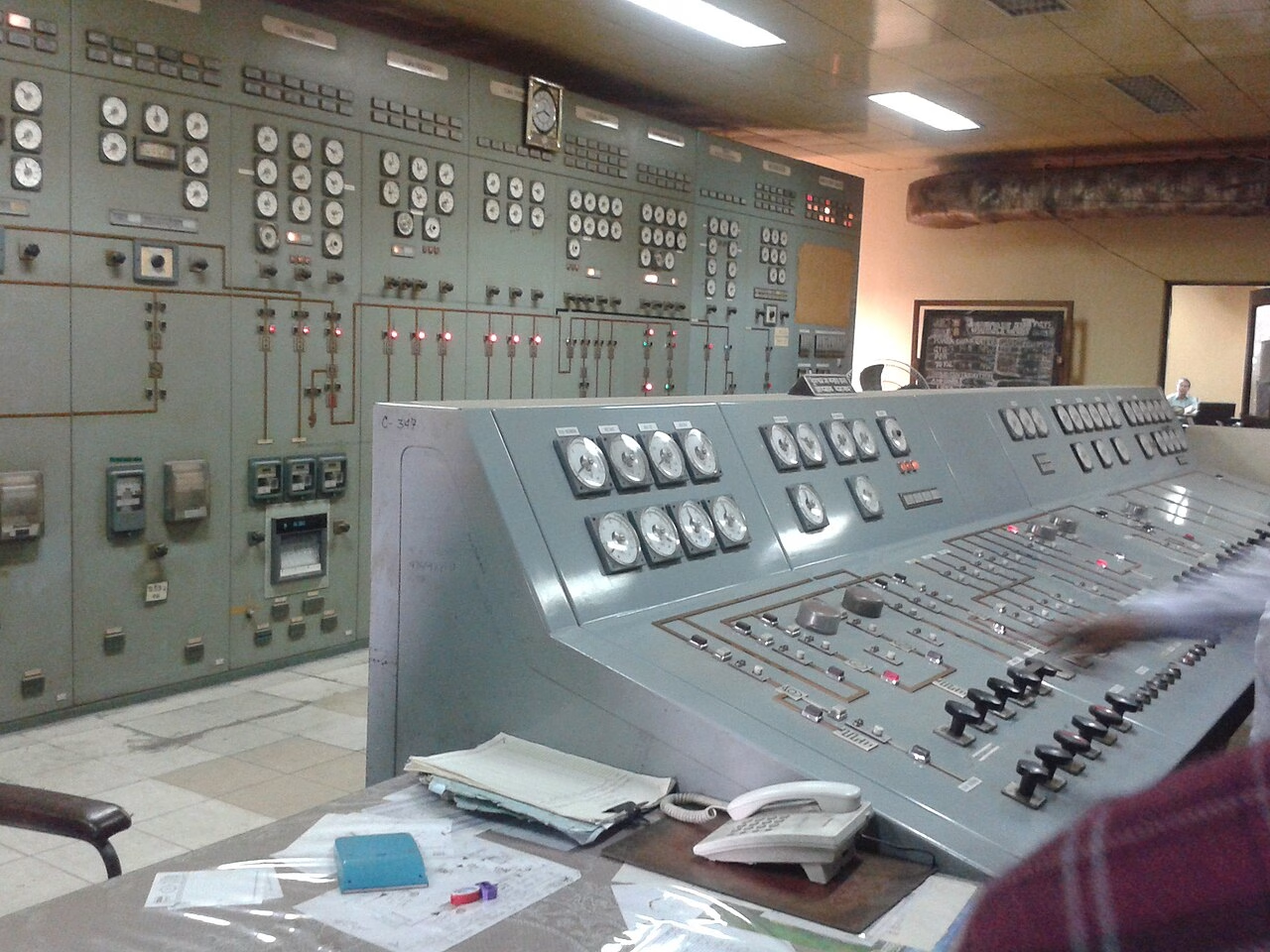
Cover photograph: A power plant control room with analogue instruments and operating records. Photo: Magnetic Rahim / Wikimedia Commons, CC BY-SA 4.0. Commons download, resized where applicable; no editorial retouching. Illustrative photograph, not a Seetalabs customer case or evidence of the results discussed.