
An OLTC operation rate rising from 400 to 600 per day changes the maintenance workload forecast. It does not prove that contact wear has increased by 50%, or that a service limit has been reached. For a furnace transformer, the useful question is what changed in the process, control behaviour and switching conditions.
Start by establishing that the count belongs to the same mechanism and a comparable period. Then relate it to the installed tap changer's maintenance basis and component evidence.
Reconcile the counter before projecting it
Consider a hypothetical OLTC counter reading of 410,000, followed by 446,000 exactly 60 days later. The records confirm no reset or motor-drive replacement.
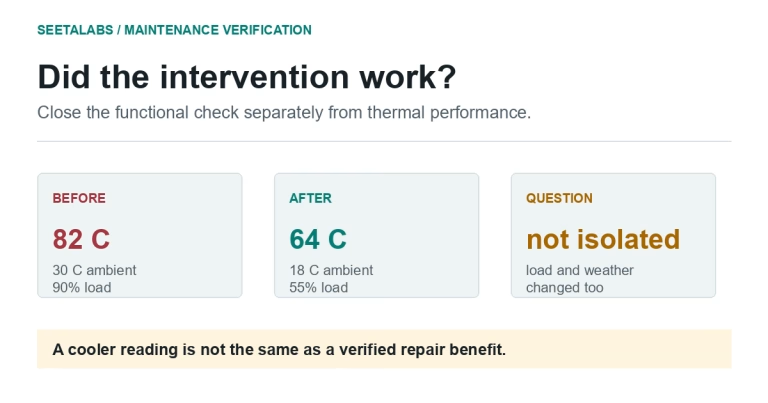
The increase is 36,000 operations / 60 days = 600 operations/day. The previous 60-day period recorded 24,000 operations, or 400 per day. The average daily rate has increased by 50%.
If each rate persisted for another 30 days, the projected additions would be 18,000 and 12,000 operations respectively. The 6,000-operation difference helps the planner test the service schedule. Neither projection estimates remaining contact life.
If a counter or drive has been replaced, preserve the link between old and new readings. A reset counter does not reset the service history of retained switching components.
Ask which evidence could change the maintenance proposal
| Observation | Question to resolve | Useful next evidence |
|---|---|---|
| More operations per calendar day | More production, more switching per heat, or both? | Furnace hours, heat count and recipe records |
| Repeated moves around a narrow tap range | Intended regulation or behaviour needing investigation? | Time-stamped tap positions and controller records |
| Count consistent with expected duty, but changed diagnostic trace | Is the comparison technically valid? | Reference setup, transition, direction and repeatability |
| Oil result labelled only "transformer" | Which compartment and fluid were sampled? | Original sampling identification and equipment arrangement |
For the same hypothetical case, suppose production rises from eight to 12 heats per day. Then 400 / 8 and 600 / 12 both give 50 operations per heat. The calendar workload has increased while that process-normalised count has not.
If production instead remains at eight heats per day, the new figure is 75 operations per heat. That distinction tells the reviewer which process and control records to examine. Neither metric measures contact wear; switching current and the equipment's design still matter.
Retrieve the applicable instructions for the actual OLTC model, switching technology and revision. Compare time and operation-based requirements with inspection findings. Do not invent a universal intervention count from this example.
Use complementary tests for a defined question
A technical conference paper on combined vibro-acoustic and dynamic-resistance assessment describes how mechanical and electrical observations can complement each other. It also discusses sensor placement and reference comparisons.
Where these tests are appropriate, document the transition and direction, reference trace and measurement setup. A changed sensor location can affect the observed signal. No single trace guarantees identification of a fault, and extra testing is not automatically justified by a higher counter rate.
Test selection and execution belong to qualified personnel under approved procedures. This is not an instruction to attach test equipment or operate a suspect tap changer on an energised transformer.
Keep furnace DGA separate from the counter
Confirm the main-tank and OLTC oil arrangements, including any communication between compartments or conservators. Use a diagnostic basis appropriate to the fluid, compartment and furnace duty; an ordinary power-transformer population is not automatically the right comparator. The IEC reference below concerns mineral-oil equipment; do not transfer its population information directly to another insulating liquid.
IEC 60599:2022, Annex A.3, specifically includes furnace transformers. Section A.3.4 and Table A.4, printed pages 27-28, provide illustrative population information, not universal limits. The table's furnace acetylene qualification also depends on OLTC design and arrangement. Do not subtract a tap-changer gas result from a main-tank result to "correct" it.
Use the DGA guide for background and the wider condition-monitoring context to retain process and intervention history. For the next service review, bring the reconciled count, heats or operating hours, tap-position record and applicable manual.
Talk to an engineer for the condition-assessment part of that review.
Sources: IEC 60599:2022, edition 4, Annex A.3, printed pages 27-28, targeted passages checked in a local reference copy; no standard table or numerical limit reproduced. Engelen et al., Practical Application of On-Load Tap Changer Vibro-Acoustic Fingerprinting and Diagnostic, CMDM, 9-11 September 2021, pages 2-5 and 7-8, public technical paper linked above. Counts, production figures and planning table are original hypothetical examples.
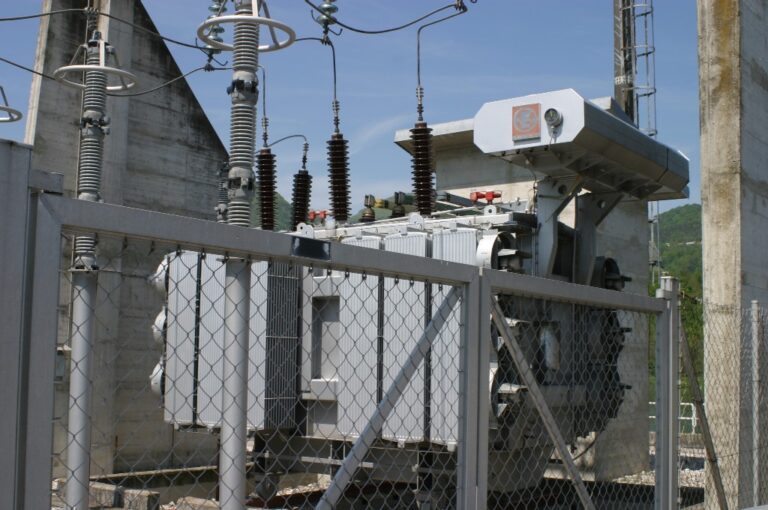
Cover: AI-generated editorial illustration of a transformer bay and steelmaking furnace. Not a customer installation, validated electrical layout or maintenance procedure.
Cover photograph: Detail of steelmaking furnace spray cooling, not a furnace transformer or tap changer. Photo: Jgraynow / Wikimedia Commons, CC BY-SA 4.0. Commons download, resized where applicable; no editorial retouching. Illustrative photograph, not a Seetalabs customer case or evidence of the results discussed.