
When two discretionary sampling requests cannot both be funded, compare the decisions they could change. A repeat needed before an unresolved maintenance proposal is approved is not equivalent to an extra baseline collected for convenience. Nor should a missing spreadsheet entry automatically trigger another site visit.
Protect required surveillance and existing engineer-directed follow-up first. The choice below concerns additional work, not permission to cancel the approved programme.
Separate committed work from a real choice
In this hypothetical campaign, EUR 12,000 is available and EUR 9,600 is committed to the approved programme. The remaining EUR 2,400 cannot cover both additional visits A and C.
All amounts and deadlines are invented. Visit costs include travel, collection, laboratory analysis and technical review.
| Request | Decision the evidence could change | Decision date | Additional cost |
|---|---|---|---|
| A: comparable repeat DGA on T-17 | Whether to include a proposed investigation in the next outage scope | In 10 days | EUR 1,800 |
| B: retrieve T-08's missing certificate | Whether the existing record already answers a baseline question | In 3 days | No additional campaign charge; staff review time still required |
| C: extra remote-site baseline on T-31 | Scope of a planning study that has not yet started | In 6 weeks | EUR 1,500 |
In this scenario, neither A nor C is an already-mandated follow-up. The diagnostic engineer has reviewed both requests and confirms that C's next required surveillance remains funded and is not being delayed.
A and C together cost EUR 3,300, exceeding the discretionary budget by EUR 900. For B, retrieve the existing certificate before buying another visit. That retrieval can proceed alongside A's review; it is not a reason to delay a time-sensitive decision on A.
Explain why one visit comes first
Suppose the engineer confirms that A can return interpretable evidence before the outage-scope decision, while C's extra baseline can be reconsidered during the later planning study. Allocate EUR 1,800 to A and retain EUR 600 for an approved contingency.
This is a reasoned choice under stated assumptions, not a universal ranking algorithm. If review of C's history reveals a new concern, the engineer must reassess the allocation. If A's laboratory turnaround misses the decision date, its apparent urgency does not make that particular purchase useful for that deadline. Reconsider the evidence route and decision timing rather than silently treating the unresolved question as closed.
CIGRE TB 962:2025, Section 3.6, printed page 41, discusses differentiating maintenance by condition and system criticality. The budget worksheet is our own planning example, not a CIGRE spending formula. A health index may help flag evidence gaps, but the score alone cannot determine which extra sample changes a decision.
Purchase the right evidence
Before approving A, confirm the compartment, insulating liquid, proposed tests and comparison records. Identify any oil processing or replacement between samples. Ask the laboratory how it will report detection limits, quantification limits and uncertainty where relevant.
IEC 60475:2022 covers sampling insulating liquids. IEC 60567:2023 covers free-gas sampling and gas analysis, with liquid sampling referred to IEC 60475. These are scope distinctions, not universal sampling intervals or a complete field procedure.
IEC 60422:2024 addresses mineral-oil and hydrocarbon-liquid condition and maintenance; equipment diagnosis through DGA and furans is outside its stated scope. Select the appropriate interpretation basis rather than treating every "oil test" as the same service. See the DGA assessment guide for that diagnostic context.
Preserve missing results and laboratory qualifiers. A <LOD report means below the reported limit of detection, not a measured zero, and substituting a limit value does not create an exact concentration for a trend calculation. IEEE C57.104-2019, Section 5.2.1, cautions about relative uncertainty near detection limits in mineral-oil DGA.
Fund the review, not just the visit
Name the reviewer and reserve time before the relevant decision. A result sitting unread in an inbox does not resolve the request that justified its cost.
Record why C's discretionary visit was deferred, the date for reconsideration and the event that would reopen it. If required work itself cannot be funded, escalate that shortfall through engineering and management; do not conceal it inside discretionary prioritisation.
Talk to an engineer about the evidence your campaign needs to clarify before the next maintenance decision.
Sources and access: CIGRE TB 962:2025, Section 3.6, printed page 41, and IEEE C57.104-2019, Section 5.2.1, printed page 27: targeted passages reread in licensed local copies. IEC 60475:2022, edition 3; IEC 60567:2023, edition 5; IEC 60422:2024, edition 5: official public scopes checked, not detailed full-text procedures. The IEC 60567 scope was read on its commented-version catalogue page. Costs and decision dates are hypothetical, not market quotations or standard requirements.
Cover: AI-generated illustration of generic site-visit logistics; not a real customer site, sampling procedure or approved electrical arrangement.
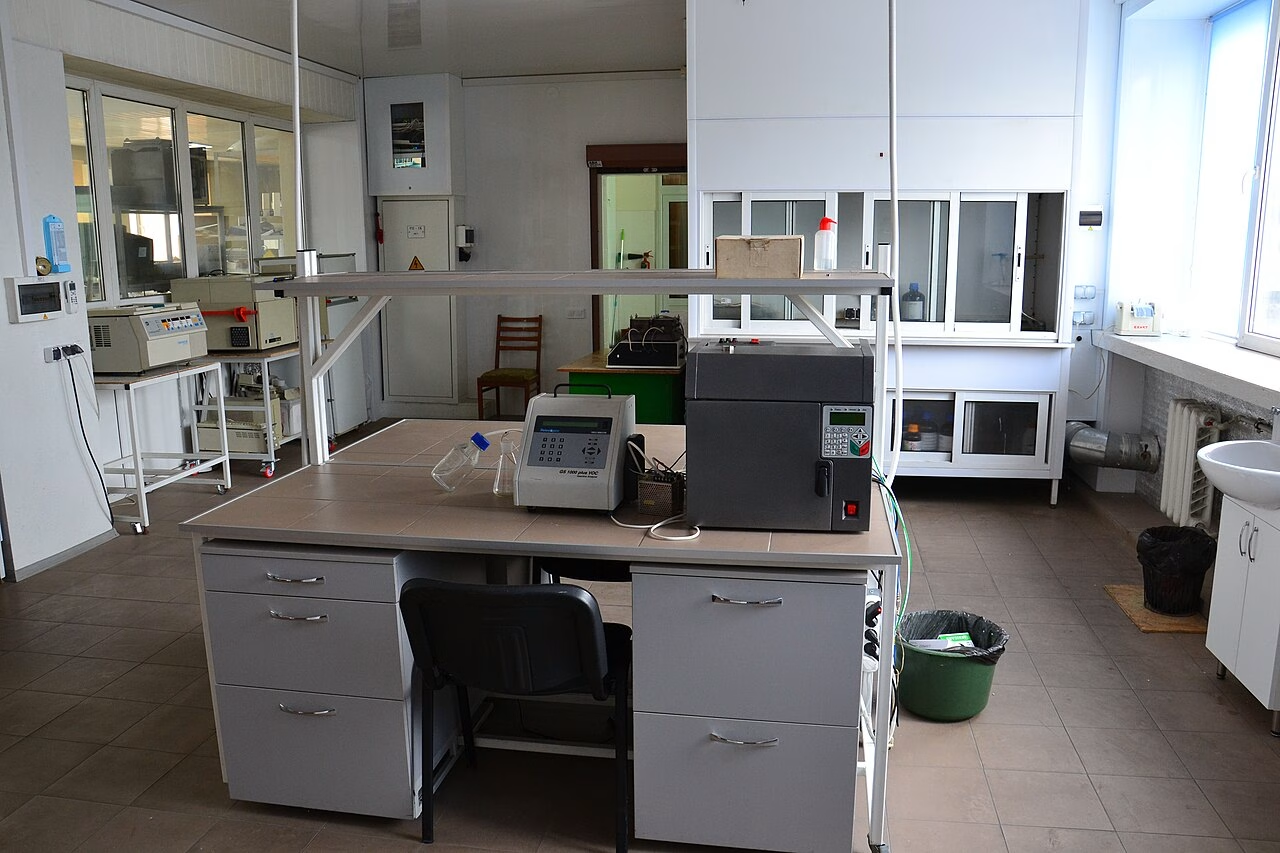
Cover photograph: Laboratory context; the photograph does not establish a particular DGA test method. Photo: NeoLyo89 / Wikimedia Commons, CC BY 4.0. Commons download, resized where applicable; no editorial retouching. Illustrative photograph, not a Seetalabs customer case or evidence of the results discussed.