
A transformer monitoring pilot can test whether engineers spend less time assembling evidence and whether difficult records receive better review. Eight weeks is one possible trial window, not a prescribed duration or a guarantee of a conclusive result. A short trial usually cannot establish how many failures a platform will prevent over the next decade.
Write the purchase decision before starting the pilot. For example: can this workflow produce an accepted condition-review pack from our laboratory files, with traceable inputs and a manageable exception queue? That question has observable answers within a short trial.
The pilot design below is an original proposal for a laboratory-based assessment workflow. It can be adapted to connected monitoring, but sensor commissioning and communications need their own acceptance work. None of the numerical examples represents a customer result or a promised return.
Select Cases That Resemble the Work Ahead
Include more than clean, complete reports. Select multiple laboratories, older and newer asset identities, uncertain sampling dates, a revised result and at least one record outside the intended assessment scope. Include relevant liquid types, but do not apply a mineral-oil method to an ester record merely to fill the pilot list.
Agree a reference review with the asset owner's engineers. Preserve disagreements instead of creating an artificial unanimous answer. The transformer health index introduction can help clarify score terminology; the pilot still needs its own definition of acceptable evidence and useful output.
IEEE C57.143-2024 includes monitoring application and risk/benefit considerations in its scope, but excludes interpretation of monitoring results. It does not validate the outcome of a particular software pilot. Build the acceptance criteria around your actual decisions, not around a general claim of standards alignment.
Divide the records between familiarization and acceptance. Suppliers can use the first group to configure mappings and understand the workflow. Keep a separate group for testing the agreed result after configuration, including realistic exceptions.
Freeze the configuration and acceptance criteria for that test. If the supplier uses its results to repair a mapping, those records have become development evidence: use fresh acceptance records for the repaired workflow. Share only synthetic or explicitly authorized data, with agreed access, retention and exit arrangements.
Control for familiarity when comparing preparation time. Use matched, previously unseen packs and reviewers with comparable experience; alternate which workflow is tested first. Repeating the same pack after an engineer has already resolved its aliases and exceptions can make the second workflow look faster for the wrong reason. Include correction work and time spent on rejected packs, with their counts visible.
Measure Work, Quality and What Remains Unknown
Track hands-on time and elapsed waiting time separately. A report that takes ten minutes to prepare but waits five days for identity clarification creates a different problem from one that takes three hours of engineering analysis.
| Measure | How to calculate or record it | What it can establish |
|---|---|---|
| Preparation effort | Total active minutes and minutes per accepted pack, with submitted and accepted counts | Work saved or shifted before interpretation |
| Traceability | Packs passing defined source-to-result checks divided by packs checked; show unchecked count separately | Evidence-link quality within the inspected set |
| Exception burden | Unresolved records by cause and owner | Data or workflow gaps before rollout |
| Review disagreement | Documented differences from the reference review | Cases needing technical explanation |
| Handover usability | Another engineer completes the agreed report checks | Whether results survive team transfer |
| Failure prevention | Observe only where outcomes and attribution support it | Usually unresolved by a short pilot |
Agree acceptance values locally before seeing the results. A universal pass percentage would conceal differences in workload, asset consequence and data quality. Include time spent on failed or rejected packs in total effort, and show their counts, so a supplier cannot improve apparent speed by quietly excluding hard cases. A sample of checked links does not establish traceability for unchecked packs.
The ISO committee's overview of ISO 55001:2024 emphasizes asset-management decision-making and value. The table applies that theme to a specific buying decision; it is not an ISO-prescribed scorecard. ISO TC 251 overview.
Work Through a Modest Benefit Calculation
Suppose a hypothetical pilot submits 40 comparable assessment packs to each workflow and all 40 eventually meet the agreed acceptance checks. Average preparation effort falls from 45 to 25 minutes per pack, including corrections and allocated exception-handling time, with the same required review and traceability checks. Total effort is 1,800 versus 1,000 minutes: a difference of 800 minutes, or approximately 13.3 hours, for the batch. These are invented values illustrating the calculation, not measured results or 40 independently observed transformer failures.
If there are 240 comparable packs annually, simple scaling suggests 80 hours a year. Label this an extrapolation. It depends on comparable files, sustained adoption and the same quality level; the pilot has not demonstrated an 80-hour annual outcome.
Now include 30 hours of one-off setup and 12 hours a year of mapping maintenance, neither already counted in per-pack effort. If all 240 comparable packs are handled in the first year, the illustrative net time saving becomes 80 – 30 – 12 = 38 hours before other work changes. A delayed start or lower volume changes that result. Do not add the 13.3-hour pilot batch again if its 40 packs are included in the annual 240.
Compare subscription, support and implementation costs separately. Do not translate these figures into money without an agreed labour-cost basis; released staff capacity is not automatically a cash saving.
Also inspect whether time was merely transferred to the laboratory, supplier or a different internal team. A faster dashboard is not a net saving if someone manually repairs every input outside the measured process.
For a failure-avoidance scenario, keep assumptions in a separate analysis: event likelihood, consequence, detection, successful intervention and uncertainty. Do not add an unobserved avoided failure to the measured pilot benefit. A condition score is not the event probability needed by that calculation.
Decide Whether to Expand, Repair or Stop the Trial
Hold the final review against the original criteria. Expansion is reasonable when the workflow is useful, material exceptions have owners and the remaining limitations are acceptable for the stated scope. A focused extension may be appropriate when one laboratory mapping remains unresolved. A pilot can also justify rejecting a poor fit.
Keep an export of the evidence, results and unresolved cases regardless of the buying decision. Our broader condition monitoring resources can support the technical discussion, but the pilot record should explain what your team actually observed.
The next action is a one-page pilot agreement covering records, responsibilities, measures, acceptance review and exit. Talk to an engineer about the evidence your assessment workflow needs to test.
Sources and Scope
- IEEE C57.143-2024: official public scope and publication date (27 August 2025) checked; full-text pilot requirements not reviewed or claimed.
- ISO TC 251 overview of ISO 55001:2024: management-system context.
Evidence checked through 30 September 2026. Pilot duration, counts and calculations are hypothetical and are not performance claims. The committee overview is supporting context, not a full reading of ISO 55001:2024 or a prescribed pilot protocol.
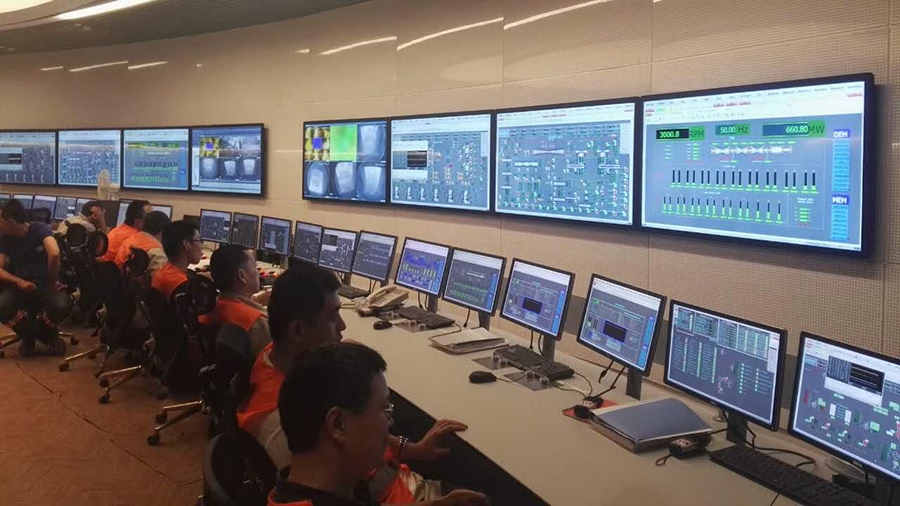
Cover photograph: Zetes-3 power station control room; not a Seetalabs software interface. Photo: Zhangmin16 / Wikimedia Commons, CC BY-SA 4.0. Commons download, resized where applicable; no editorial retouching. Illustrative photograph, not a Seetalabs customer case or evidence of the results discussed.